
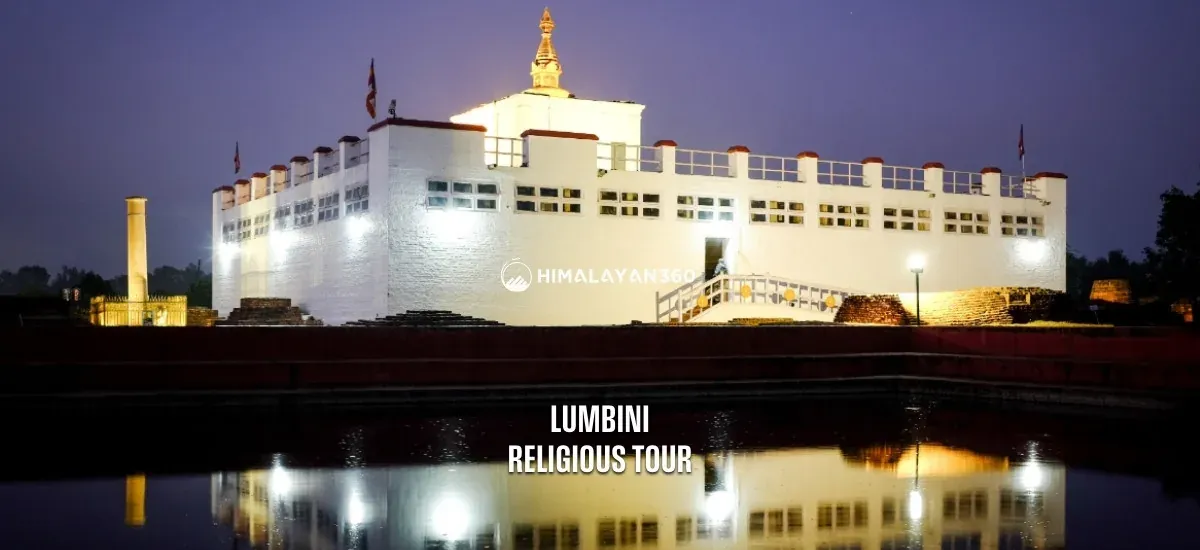
Nepal holds exactly one of the four places the Buddha himself named as worth a pilgrimage. That place is Lumbini, where he was born, and it is a UNESCO World Heritage Site inscribed in 1997. The other three, Bodh Gaya, Sarnath and Kushinagar, are in India.
The practical numbers first. The Lumbini Development Trust charges a daily conservation fee of NPR 700 for other nationals, NPR 400 for SAARC nationals plus Myanmar, NPR 80 for Indian nationals and NPR 20 for Nepali nationals. Lumbini is about 272KM from Kathmandu, 9 to 10 hours by tourist bus, and about 20KM from the airport at Bhairahawa. Buddha Purnima falls on the full moon of Baisakh, so its date in the Western calendar moves every year.
This page is about the sites and the logistics of reaching them. It is not a package. Itinerary links appear where they are genuinely the answer.
The Four Places the Buddha Named
This is the first thing worth getting straight, because it decides how much of your trip is even in Nepal.
Buddhist tradition holds that the Buddha identified four sites of future pilgrimage: the place of his birth, the place of his enlightenment, the place of his first sermon, and the place where he passed into nirvana. The Kathmandu Post, reporting from Lumbini in May 2026, restates it the same way, describing Lumbini as one of four sacred pilgrimage sites alongside the place of enlightenment, the site of the first sermon and the place of nirvana.
Of those four, only Lumbini is in Nepal. Bodh Gaya, Sarnath and Kushinagar are all in India. That is why an honest Buddhist pilgrimage circuit is usually a cross border affair, and why a Nepal-only pilgrimage is built around Lumbini and the archaeological sites near it rather than around all four.
What Nepal does have, and has a great deal of, is the surrounding evidence. Tilaurakot is the ancient Shakya capital where Siddhartha grew up. Ramagrama holds relics of the Buddha in a stupa that has never been opened. And the Kathmandu Valley carries a living Buddhist tradition in the two great stupas of Swayambhu and Bauddhanath. Those are the pieces the rest of this page covers.
Lumbini at a Glance
| Status | UNESCO World Heritage Site, inscribed 1997 under criteria (iii) and (vi) |
| Official name | Lumbini, the Birthplace of the Lord Buddha |
| Where | Rupandehi district, in the Terai plains of southern Nepal |
| The pillar | Erected by the Mauryan Emperor Asoka in 249 BC, with a Pali inscription in Brahmi script |
| Rediscovered | 1896, when the Asoka pillar was found |
| Master plan area | About 770 hectares, one mile east to west and three miles north to south |
| Managed by | Lumbini Development Trust, under the Ancient Monument Preservation Act 1956 |
| Entry fee | NPR 700 per day for other nationals, NPR 400 SAARC and Myanmar, NPR 80 Indian, NPR 20 Nepali |
| Nearest airport | Gautam Buddha International, Bhairahawa, about 20KM |
| From Kathmandu | About 272KM, 9 to 10 hours by tourist bus |
| From Pokhara | About 169KM, 6 to 7 hours by bus |
| From Chitwan (Sauraha) | About 131KM, 5 to 6 hours by bus |
| Altitude sickness risk | None. This is the Terai, not the mountains |
UNESCO's own citation is worth reading closely, because it is more careful than most travel copy. It records that the Buddha was born in 623 BC in the sacred area of Lumbini, testified by the inscription on the pillar erected by Asoka. The evidence is the inscription, and the site earns its listing on the strength of that plus the excavated remains of monasteries from the 3rd century BC to the 5th century AD and stupas from the 3rd century BC to the 15th century AD.
What Lumbini Entry Actually Costs
This is one of the most searched things about Lumbini and one of the most consistently wrong on the open web. The table below is the one published by the Lumbini Development Trust itself.
| Fee | Nepali | Indian | SAARC + Myanmar | Other nationals |
|---|---|---|---|---|
| Conservation, per day | NPR 20 | NPR 80 | NPR 400 | NPR 700 |
| Still camera, per day | NPR 100 | NPR 100 | USD 3 | USD 3 |
| Video camera, per day | NPR 1,000 | NPR 1,000 | USD 25 | USD 25 |
| Short video, music video, documentary | NPR 3,000 | NPR 3,000 | NPR 3,000 | NPR 3,000 |
| Meditation pass, 12 days | Free | NPR 500 | NPR 500 | NPR 1,000 |
Two things to take from that. First, the fee is per day, not per visit, which matters if you are staying to meditate rather than to sightsee. Second, the Trust states that the conservation fee is waived for monks, nuns, persons with disabilities, and local residents of the three surrounding districts.
Now the honest caveat. Well researched independent guides still publish a different set of numbers for the same gate, quoting free entry for Nepalis, NPR 16 for Indians and NPR 200 for other SAARC nationals, with NPR 700 for foreigners. The foreigner figure agrees; the rest does not. The Kathmandu Post's May 2026 reporting notes that questions have been raised locally over the charging of entry fees to Nepali visitors at all, which is probably why the published figures have moved and the secondary sources have not caught up. Buy at the ticket office or through the Trust's ticketing site and treat any number you read elsewhere, including this page, as a guide rather than a quote.
One useful navigational detail: the main ticket office is up at the gates of the Maya Devi Temple, not at the entrance to the development zone, which is where older guidebooks send you.
Getting to Lumbini: Distances and Journey Times
Lumbini is the awkward one in Nepal's tourist geography. It is a long way from Kathmandu and much closer to places most visitors are already going.
| From | Distance | By bus | Typical fare |
|---|---|---|---|
| Kathmandu | About 272KM | 9 to 10 hours | NPR 1,600 to 1,800 |
| Pokhara | About 169KM | 6 to 7 hours | NPR 1,400 to 1,600 |
| Chitwan (Sauraha) | About 131KM | 5 to 6 hours | Around NPR 1,400 |
| Sunauli, the Indian border | About 28KM | About 30 minutes | From around NPR 600 |
| Bhairahawa airport | About 20KM | About 30 minutes by taxi | Around NPR 1,000 |
Where these come from: the distances and fare bands are those published by David Ways of The Longest Way Home, an independent Nepal guidebook author who states the page was verified in June 2026. Other sources put Kathmandu to Lumbini as high as 330KM, which is a different routing rather than a contradiction, so plan around the journey time instead of the kilometres.
The practical reading of that table is that Chitwan is the easy approach and Kathmandu is the hard one. Sauraha to Lumbini is five hours. Kathmandu to Lumbini is a full day on the road. If Chitwan or Pokhara are already in your plan, put Lumbini next to one of them rather than treating it as a Kathmandu day trip, because it is not one.
Flying changes the arithmetic completely. Gautam Buddha International Airport at Bhairahawa began handling international flights on 16 May 2022, when a Jazeera Airways service arrived from Kuwait, making it Nepal's second international airport. Published schedules put Kathmandu to Bhairahawa block times at around 35 minutes, while operators quote anywhere between 25 and 45; the sources disagree enough that the only safe statement is under an hour. Against 9 to 10 hours on a bus, that is not a close contest if the budget allows.
The Buddha Chowk Problem
This deserves its own heading because it catches almost everybody once.
Many buses sold as going to Lumbini do not go to Lumbini. They go to Buddha Chowk, a junction on the highway near both Bhairahawa and Lumbini, and they put you out there. The fix is simple once you know it: get out, cross the road, walk down the main road opposite, and take a local bus the last stretch into Lumbini Bazaar, which is the settlement beside the Maya Devi Temple. It is roughly a 20 minute ride.
There are direct services. Sakura Holidays and Lord Krishna Holidays both run tourist buses from Kathmandu's Gongabu bus park through to the Lumbini development zone. Greenline, which appears on a great many travel pages as the premium option on Nepali highways, has not run this route for years, so do not build a plan around that name.
Also worth knowing: three towns near Lumbini get used interchangeably and are not the same place. Lumbini Bazaar is where the accommodation and the temple are. Bhairahawa, officially Siddharthanagar, is the town 20KM away with the bus station and the airport. Butwal is a larger transport hub further out, and if a bus is going to Butwal rather than Bhairahawa you have added a leg.
What Is Built at Lumbini and What Is Not
Most pages about Lumbini describe the master plan as though it were finished. It is not, and knowing that changes what you pack and how you plan the day.
The master plan was designed by the Japanese architect Kenzo Tange, commissioned in 1972 after UN Secretary-General U Thant visited the neglected site in April 1967, and submitted in 1978. UNESCO records the planning as carried out with the United Nations between 1972 and 1978. It covers roughly 770 hectares, one mile east to west and three miles north to south, and it was originally meant to take 17 years. The Kathmandu Post reported in May 2026 that it has now taken 48 years and is still incomplete.
The progress figures are worth quoting because they are contested even internally. The Trust's member secretary put completion at more than 88 percent in 2026. His predecessor put it at 84 percent in 2020. That is roughly four percentage points in six years, and one expert quoted in the same report said plainly that there is no scientific basis for either number.
What that means on the ground:
- Completed. The landscaping of the Sacred Garden, the central canal, the symbolic pavilion, and the north and south ponds. The Sacred Garden at the southern end holds the Maya Devi Temple, the Asoka pillar and the archaeological remains, and it is the part of Lumbini that fully delivers.
- Not built. A 420-seat U Thant auditorium and six large two-storey circular buildings remain unbuilt after nearly five decades.
- Still missing. A primary health centre, a bus park, souvenir shops, restaurants, a high school, pilgrim accommodation, dedicated meditation and recitation spaces, waste management, and a water tower and distribution network.
- Under construction. About a third of the monasteries and temples in the monastic zone are still being built, and others may simply be closed on the day you visit.
The blunt practical consequence is that there is very little food or water available once you are inside the development zone. There is one small stall selling local food and bottled drinks in the Lumbini Museum area, and that is close to it. Carry water and a packed lunch. For a site that receives pilgrims from across the Buddhist world, that is a genuinely surprising gap, and it is the single most useful thing on this page.
The International Monastic Zone: Theravada East, Mahayana West
Between the Sacred Garden and the unfinished New Lumbini Village lies the International Monastic Zone, and it has a logic that almost nobody explains before you arrive.
A central canal runs the length of the plan. Monasteries of the Theravada traditions sit east of that canal. Mahayana monasteries sit west of it. Sri Lanka, Myanmar, Thailand and Cambodia have built on the eastern side. China, Singapore, Japan, South Korea, France, Germany, Vietnam and Canada are represented on the western side. Walking the zone is therefore not a random tour of pretty buildings; it is a walk across the doctrinal map of modern Buddhism, and the architecture changes accordingly as you cross the water.
Covering it takes transport, because the plan is three miles long. Bicycles hire for around NPR 200 for the day and the ground is completely flat. Battery-assisted rickshaws with a driver wait just inside the main entrance and along the road inside the park, and they run two circuits: an inner monastic tour of 3 to 4 hours covering both sides of the canal at around NPR 500 to 800, and a full outer tour of about 6 hours that reaches the World Peace Pagoda at the northern end, at around NPR 800 to 1,000. Drivers tend to prefer the inner tour because the outer one crosses rough ground.
If you would rather have the Sacred Garden and the monastic zone guided and the Bhairahawa flights built in, the Lumbini tour of Nepal is the three day version of exactly this, flying into Bhairahawa on day one and covering the Maya Devi Temple, the Asoka pillar and the monastic zone before heading out to Kapilvastu.
Kapilvastu, Ramagrama and the Greater Lumbini Sites
Lumbini is the birth. The rest of the story sits in the districts around it, and this is the part of a Nepal pilgrimage that most visitors skip and then regret skipping.
Tilaurakot is the archaeological remains of Kapilavastu, the Shakya capital where Siddhartha spent his early life before leaving it. It has been on UNESCO's Tentative List since 1996, entered as "Tilaurakot, the archaeological remains of ancient Shakya Kingdom", and Nepal has been working toward a full nomination. It is not a temple. It is a walled city plan, palace foundations and gates, and it rewards a guide who can read it for you.
Ramagrama is the more remarkable of the two, and the reason is a single sentence in UNESCO's own tentative list entry. Ramagrama is described there as the only undisturbed original stupa containing relics of Lord Buddha, built in the 6th century BC. Every other one of the original relic stupas was opened and its contents redistributed. This one was not. It has been on the Tentative List as "Ramagrama, the relic stupa of Lord Buddha" since 1996, and it sits in Nawalparasi, east of Lumbini. There is no grand temple over it, which is exactly the point.
Around those two are the smaller Kapilvastu sites. Gotihawa is associated with Krakuchhanda, one of the Buddhas held to have preceded Gautama, and has the stump of an Asokan pillar. Niglihawa, also known as Nigali Sagar, is associated with Kanakamuni and holds fragments of an Asokan pillar carrying a 3rd century BC inscription. Then there are Kudan, Sagarhawa and Devdaha. They are rural, quiet, thinly signposted and almost entirely free of crowds.
Distances are the reason these get skipped. Working from the operator itinerary that covers them, Lumbini to the Kapilvastu cluster and back is about 87.5KM and 2 hours 20 minutes of driving, and the Ramagrama leg is about 82KM. That is a full day each, which is why a serious Nepal pilgrimage is three days rather than one, and why a same-day attempt from Lumbini Bazaar without a vehicle does not work.
The Kathmandu Valley Buddhist Sites
The Kathmandu Valley was inscribed on the World Heritage List in 1979 as seven monument zones, and two of those seven are Buddhist. UNESCO describes Swayambhu as including the oldest Buddhist monument in the Valley, and Bauddhanath as including the largest stupa in Nepal. Both are working religious sites rather than ruins, with kora circuits walked daily.
What makes the Valley worth building into a pilgrimage rather than treating as an arrival airport is the fusion UNESCO singles out in its own citation: the coexistence and amalgamation of Hinduism and Buddhism with animist ritual and Tantrism, which it calls unique, developing from at least the 5th century AD and reaching its height between 1500 and 1800.
South of the city, Pharping is a hillside of shrines significant to Vajrayana practitioners, and Namo Buddha east of the Valley is associated with the story of the prince who gave his body to a starving tigress. Both are day trips from Kathmandu rather than destinations in themselves.
Chaining the Valley, Pokhara and Lumbini into one journey is the standard shape of a longer trip, and the Buddhist pilgrimage tour through Kathmandu, Pokhara and Lumbini is the nine day version, taking in Boudhanath and Swayambhunath, a Pharping day, the World Peace Stupa and Tibetan settlement at Pokhara, then Lumbini itself, on a route of roughly 835KM out and back.
Buddha Purnima and How Its Date Is Set
This is the question the search data shows people asking most often about the festival, and the answer is mechanical rather than mystical.
Buddha Purnima, known in Nepal as Buddha Jayanti and across much of Asia as Vesak, falls on Baisakh Purnima: the full moon day of the month of Baisakh. It marks three events at once, held by tradition to have happened on the same lunar date: the birth, the enlightenment and the parinirvana of the Buddha. It is a national public holiday in Nepal.
Because it is fixed to a lunar month rather than a solar one, its date in the Western calendar moves every year, generally landing in April or May. That is not a quirk to work around; it is the whole basis of the date. The United Nations, which recognised the Day of Vesak by General Assembly resolution 54/115 in 1999, describes it as the day of the full moon in May and notes explicitly that the calendar date changes from one year to the next.
The practical instruction that follows is simple. Do not book flights around a remembered date or a number you read on a travel blog. Check Nepal's official public holiday list for the year you are travelling, then book, because Lumbini's accommodation fills for it and the crowds on the day are the largest of the year.
If the festival is the reason for the trip rather than an accident of timing, the six day Buddha Purnima celebration in Lumbini is built around being in the Sacred Garden on the day itself, with the Kathmandu Valley sites and Ramagrama in the days either side of it.
Rules and Practicalities Inside the Complex
Lumbini is an active religious site and the rules are enforced rather than suggested.
- Shoes come off. The Lumbini Development Trust states that visitors must remove their shoes before entering the temple premises, and removing them for the Maya Devi Garden area is now mandatory. Socks are your friend on hot brick.
- No food or drink inside the temple. The Trust asks that these be left at the entrance.
- Dress modestly. Long sleeves and long trousers. This is not a beach temple where a sarong is handed out at the gate.
- Cameras. A still camera is covered by a separate daily fee, and there are prominent no-camera signs inside the temple itself. Video attracts a much larger fee.
- Walk clockwise around stupas and sacred objects, do not climb on the archaeological remains, and do not try to enter closed monasteries.
- The pond is for looking at. Bathing in the Puskarini, the Shakya Tank beside the temple, is not appropriate. Sitting under the Bodhi tree beside it is.
- Opening hours are the one thing nobody official publishes. The Lumbini Development Trust's site does not state them, and the third party listings that do contradict each other. Go in the morning, do not count on a late afternoon entry, and confirm at the ticket office.
On timing across the year, remember the geography. Lumbini is in the Terai plains, not the hills, so the pre-monsoon months are genuinely hot and the monsoon is wet and humid. The autumn and spring windows that suit trekking in Nepal suit the Terai as well, with the added point that the Himalaya is not the view here, so a cloudy day costs you far less than it would at a mountain viewpoint.
 Trek
Trek By air
 Pilgrimage
 Festivals
 Wildlife
 Luxury
 Yoga
Yoga Food
Food Heritage