Kilimanjaro is the harder of the two for most trekkers, because it goes higher in less time: Uhuru Peak is 5,895 m, reached in five to eight days with a long summit night. Everest Base Camp is the longer trek, about 14 days, but the altitude builds more gradually and tops out lower, at 5,545 m on Kala Patthar. So the honest answer to EBC vs Kilimanjaro is that they test different things. Kilimanjaro is an altitude test and the shorter trek; EBC is an endurance trek, and for most first-timers it is easier than Kilimanjaro.
Kilimanjaro and Everest Base Camp are both bucket-list walks with no technical climbing, both take you above 5,000 m, and both are done by first-time trekkers every season. This page compares them on height, difficulty, acclimatisation, days and distance, cost, accommodation, scenery and the best time to go, using the itinerary we run to Everest Base Camp and the fees Tanzania publishes for Kilimanjaro National Park.
Everest Base Camp vs Kilimanjaro at a Glance
| Everest Base Camp | Kilimanjaro |
|---|
| Highest point | Kala Patthar, 5,545 m (base camp 5,364 m) | Uhuru Peak, 5,895 m |
| Country | Nepal, in the Everest region | Tanzania, in Kilimanjaro National Park |
| Days on the mountain | About 12, within a 14-day trip | 5 to 9, depending on the route |
| Distance | 114.5 km on our itinerary, out and back from Lukla | About 60 to 90 km, depending on the route |
| Summit night | None; a dawn hike up Kala Patthar | Yes, starting around midnight |
| Accommodation | Teahouse lodges | Tents, or huts on the Marangu route |
| Getting there | Flight to Lukla (2,860 m) | Drive to a park gate from Moshi or Arusha |
| Guide | Not currently enforced in the Everest region, but most trekkers use one | Required by the park |
Is Everest Base Camp Higher Than Kilimanjaro?
No. Kilimanjaro is higher than Everest Base Camp by about 530 m, and higher than the top of the EBC trek by 350 m. Everest Base Camp sits at 5,364 m on the Khumbu Glacier. The highest point you reach on the EBC trek is Kala Patthar, 5,545 m, a viewpoint above Gorak Shep that you climb for the view of Everest at sunrise.
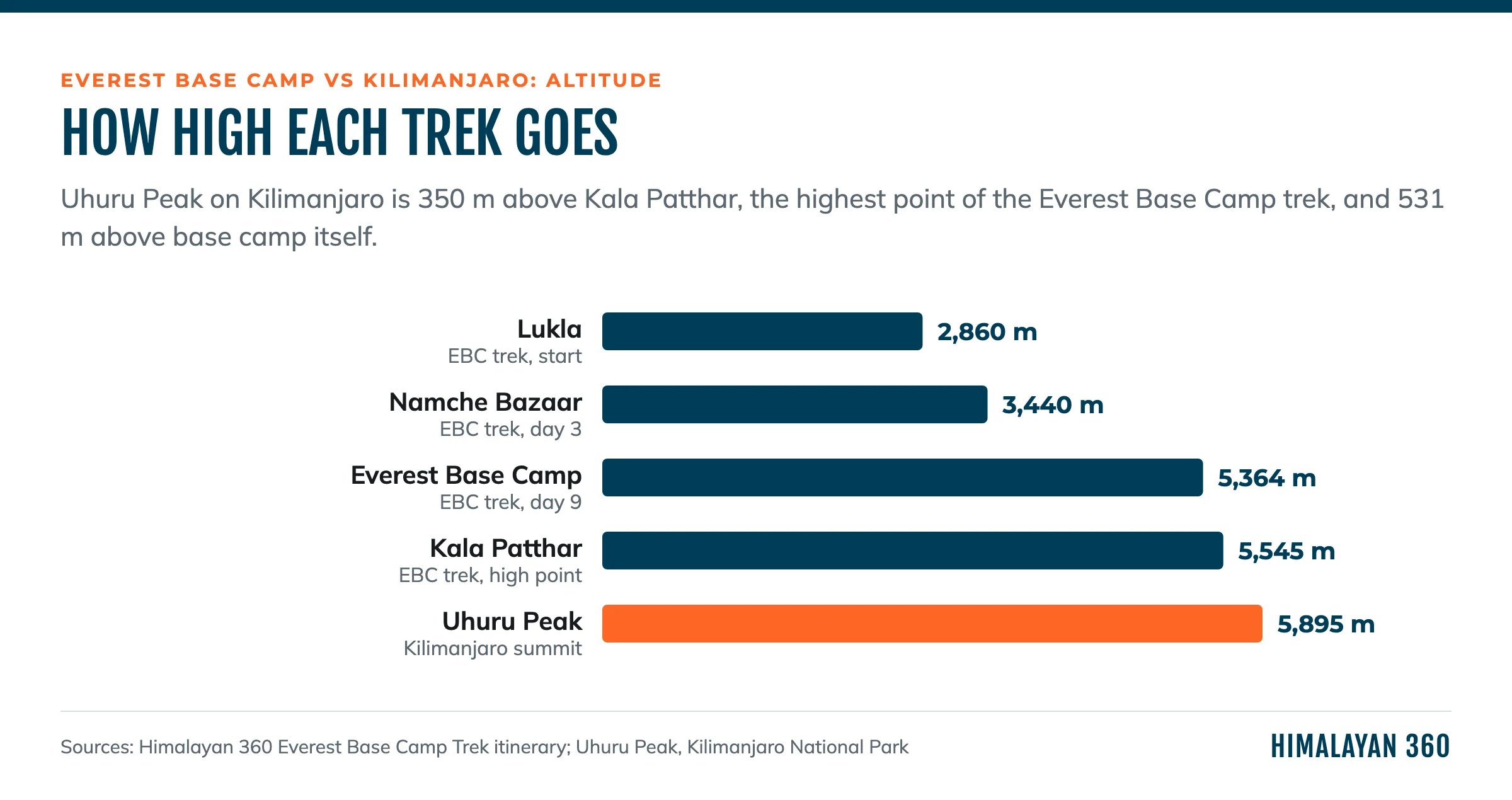
Uhuru Peak on Kilimanjaro is 5,895 m. Mount Kilimanjaro is located in northern Tanzania and is the highest mountain in Africa, the "roof of Africa". It is also the tallest free-standing mountain in the world: Kilimanjaro stands alone above the plains rather than in a mountain range. Compared to Everest, it is a much smaller mountain, but a far higher summit than anything you reach on the trek to EBC. Mt Everest itself, at 8,848.86 m, is a different undertaking altogether: the trek to Everest Base Camp takes you to its foot, not its summit.
Which Is Harder, Everest Base Camp or Kilimanjaro?
Kilimanjaro is harder in a short burst; Everest Base Camp is harder over time. The difficulty levels differ in three ways, and what makes Kilimanjaro harder is mostly the first two.
Summit night. On Kilimanjaro you leave the high camp around midnight and climb for most of the night, roughly 1,200 m of ascent in the cold and dark, to reach the crater rim and Uhuru Peak around sunrise. Then you descend a long way the same day. Summit day is the hardest single day on either trek, and summiting is a mental and physical test as much as a walk. Every climber does it on Kili, the nickname most guides use for the mountain, whichever route they take. The EBC trek has nothing like it: the hardest days are the walk from Lobuche to base camp and back to Gorak Shep, and the pre-dawn hike up Kala Patthar.
Speed of ascent. A Kilimanjaro climb gains about 4,000 m from the park gate to the summit in five to eight days. On our Everest Base Camp Trek you start at Lukla, 2,860 m, and reach 5,545 m on day 10, with acclimatisation days at Namche Bazaar and Dingboche on the way. The daily elevation gain is smaller throughout the trek.
Length. EBC is the longer trek: about 12 days of walking and 114.5 km on our itinerary, against five to nine days on Kilimanjaro. Most days are five to seven hours on rocky trail, and fatigue builds up. Trekkers who find Kilimanjaro is harder usually mean summit night; those who find EBC harder usually mean the second week.
Neither needs technical skills, ropes or previous climbing. Both reward the same preparation: weeks of long walks on hills with a loaded day pack.
Acclimatisation and Altitude Sickness on EBC and Kilimanjaro
Altitude sickness is the real difficulty on both treks, and the risk is higher on Kilimanjaro because the ascent is faster. Acute mountain sickness comes from gaining height faster than your body can adjust, and it affects fit and unfit trekkers alike.
The EBC trek is built around gradual acclimatisation. Above 3,000 m our itinerary gains roughly 300 to 500 m of sleeping altitude a day, with two rest days for climbing high and sleeping low: a hike to Hotel Everest View from Namche Bazaar, and a hike above Dingboche to about 5,083 m. Our page on altitude and acclimatisation on a Nepal trek explains how to read an itinerary for this before you book.
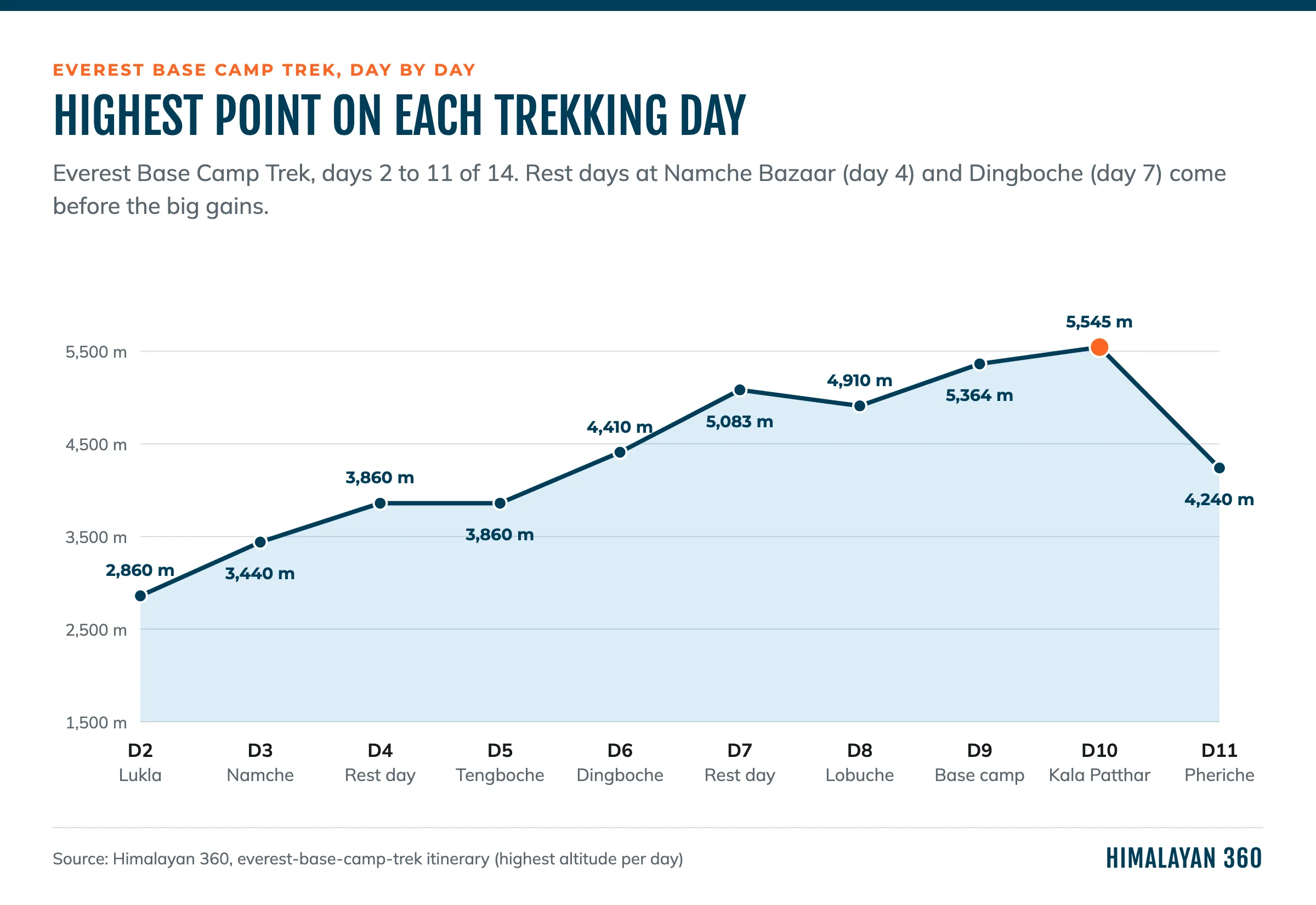
Highest point on each trekking day of our Everest Base Camp itinerary. The rest days on days 4 and 7 come before the big gains.
On Kilimanjaro, acclimatisation depends almost entirely on the route you choose. The quickest routes allow little time to adjust, which is why the summit success rate is lower on short itineraries and higher on seven and eight day routes such as the Lemosho or a seven-day Machame. Overall summit success figures quoted by operators vary widely, but they agree on that point: the longer the Kilimanjaro summit climb, the better your chance of standing on Kilimanjaro's summit. Nobody climbs Kilimanjaro without a licensed guide, and good guides will turn you back at higher altitudes if you show signs of serious illness. If you take one thing from this comparison, it is this: on Kilimanjaro, pay for the extra day.
How Long Each Trek Takes
The Everest Base Camp trek takes about 14 days from Kathmandu; a Kilimanjaro trek takes five to nine days on the mountain.
Our EBC itinerary is 14 days: arrival in Kathmandu, the flight to Lukla, eight days up the valley with two acclimatisation days, base camp on day 9, Kala Patthar on day 10, three days back down to Lukla and the flight out. If you are short of time, the Everest Base Camp Trek with Helicopter Return flies you out from Gorak Shep and saves the walk down.
On Kilimanjaro the main routes are:
| Kilimanjaro route | Days | Approximate distance |
|---|
| Marangu | 5 to 6 | About 70 km |
| Machame | 6 to 7 | About 61 km |
| Lemosho | 7 to 8 | About 67 km |
| Northern Circuit | 8 to 9 | About 88 km |
Add a day or two for travel to Tanzania and a night before and after the climb, and a Kilimanjaro trip still fits in around ten days, which is its biggest advantage over EBC.
Everest Base Camp vs Kilimanjaro Cost
Everest Base Camp is usually cheaper than Kilimanjaro, mainly because of Kilimanjaro's park fees. Tanzania National Parks charges a conservation fee of USD 70 per adult per day on Kilimanjaro, plus a USD 20 rescue fee per trip, and camping of about USD 50 a night is added on most routes, or about USD 60 a night in the Marangu huts. On a seven-day Lemosho climb that comes to roughly USD 800 per person in national park entry and camping fees alone, before guides, porters, food, transfers and tips.
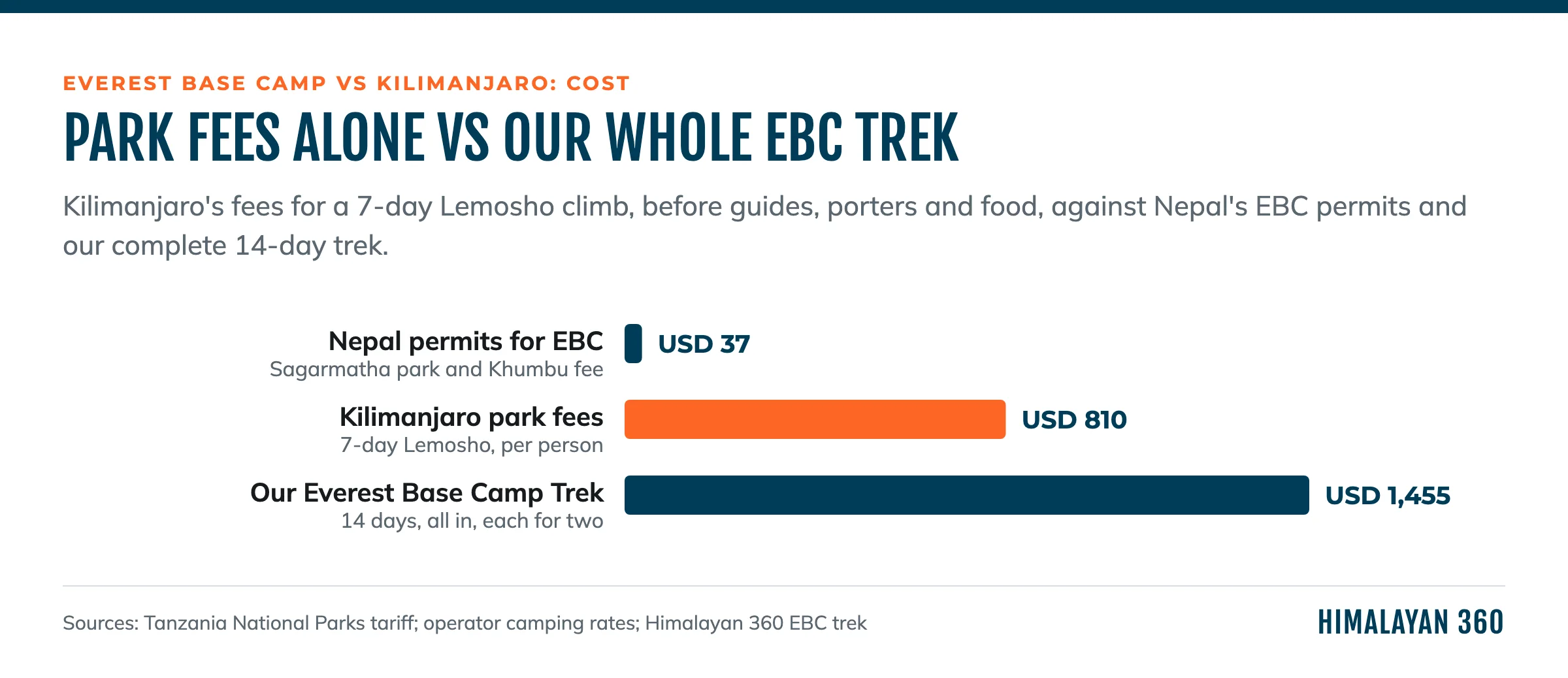
The fees in Nepal are much smaller. The Sagarmatha National Park permit is NPR 3,000 and the Khumbu Pasang Lhamu Rural Municipality fee NPR 2,000, about USD 37 together. Our 14-day Everest Base Camp Trek costs USD 1,815 for one trekker, USD 1,455 each for two or three, and from USD 1,260 each in a large group, and that includes the Kathmandu to Lukla flights, both permits, 11 nights in teahouses, meals on the trek, two hotel nights in Kathmandu and a government-licensed trek leader. A porter is extra.
Flights decide the rest: the international fare to Kathmandu or to Kilimanjaro International Airport often matters more than either trek price.
Teahouses vs Tents: Where You Sleep
On the EBC trek you sleep in teahouse lodges every night; on Kilimanjaro you sleep in tents, unless you take the Marangu route with its mountain huts.
Teahouses are family-run lodges in Sherpa villages, a different lodge most nights: a twin room, a dining room with a stove, and meals cooked to order. They get simpler and colder as you climb, but you are indoors and you meet other trekkers and local people in the evenings. Walking between villages like Namche Bazaar and Tengboche, with its monastery, is part of what makes the trek.
On Kilimanjaro you share a tent, and a team of porters carries tents, food and water, and a cook prepares meals at each camp. The camps are on bare mountainside rather than in villages, and nights near the summit drop well below freezing. It is more of an expedition feel, and you will be grateful for a good sleeping bag.
Scenery and Terrain on Each Trek
EBC gives you the closest mountain views on Earth; Kilimanjaro gives you the most varied walk. On the Everest base camp route you walk among the world's highest peaks the whole way, with Ama Dablam, Lhotse, Nuptse and Everest itself, and the view of Everest from Kala Patthar at sunrise is the reason most people go.
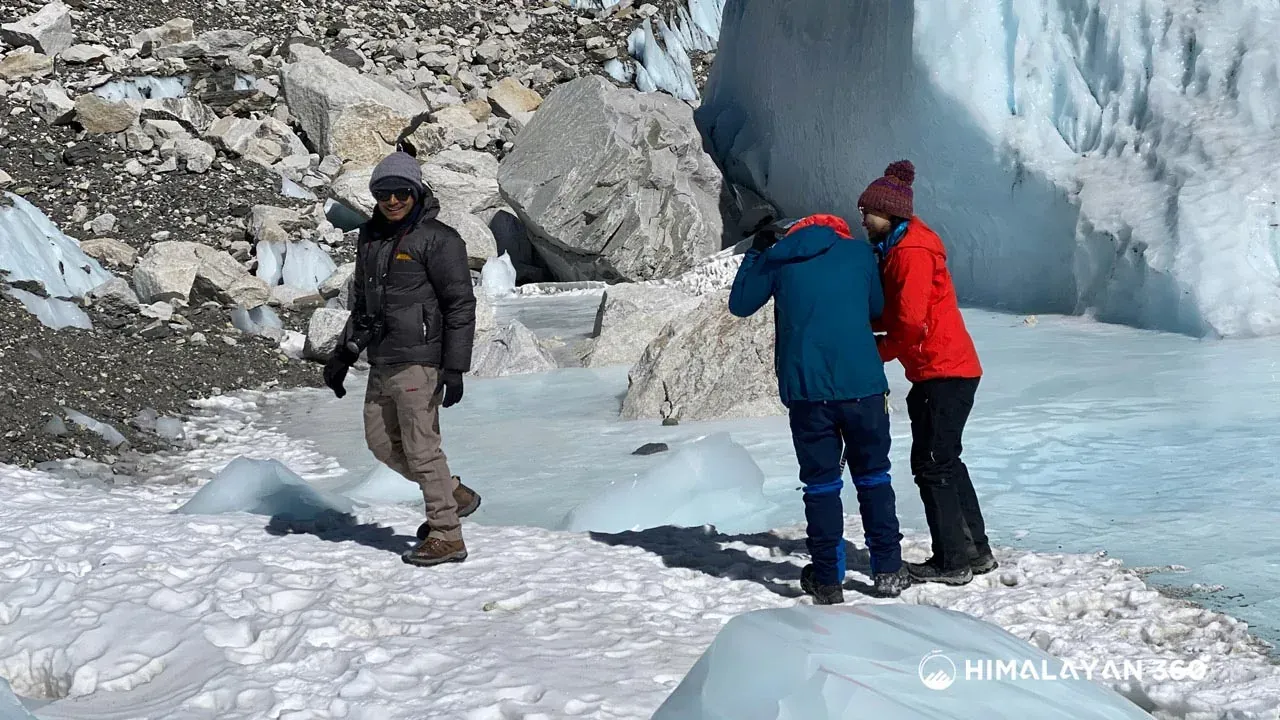
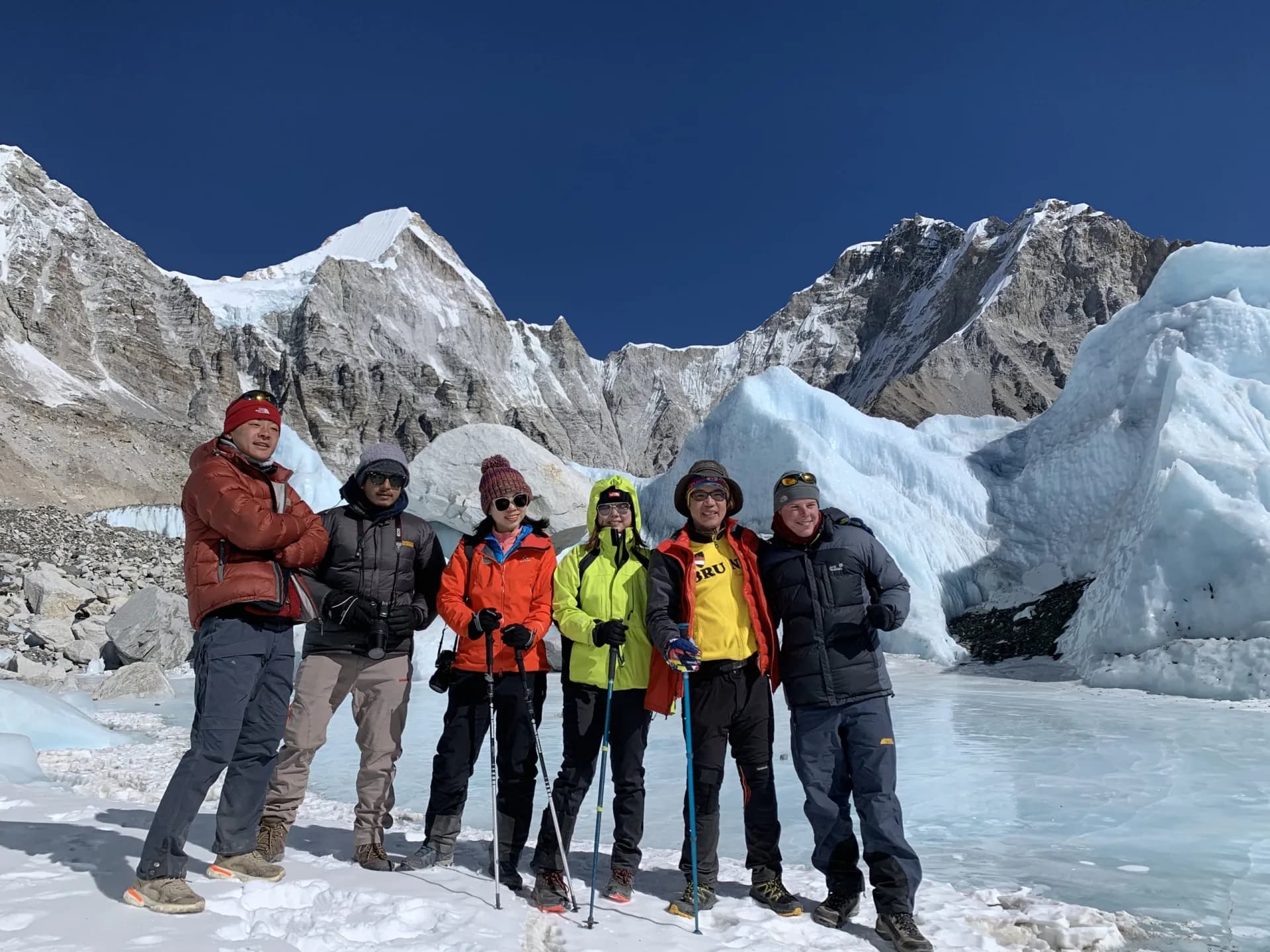
Trekkers on the Khumbu Glacier on the way to Everest Base Camp from Gorak Shep.
Kilimanjaro climbs through distinct zones in a few days: rainforest at the bottom, then moorland, alpine desert and finally the arctic summit zone of glaciers and scree around the crater. You see the mountain you are climbing rather than a range around you, and on clear mornings the plains of Africa below.
Best Time for Everest Base Camp and Kilimanjaro
Go to Everest Base Camp in March to May or October to November; climb Kilimanjaro in its dry seasons, January to early March and June to October. In the Everest region autumn brings the clearest skies after the monsoon and spring the warmer days and rhododendrons. December and February are possible but cold, and the monsoon from June to September brings cloud and cancelled Lukla flights.
Kilimanjaro's two rainy seasons are roughly mid-March to May and November, when the trails are wet and the summit views less reliable. Because the best months only partly overlap, you can do both in one year: Kilimanjaro in January or August, EBC in spring or autumn.
Kilimanjaro or Everest Base Camp: Which Should You Do First?
Choose Kilimanjaro if you have about a week, want a true summit to stand on, and are happy with camping and one very hard night. Pick a route of seven days or more.
Choose Everest Base Camp if you have two weeks, want to walk among the highest mountains in the world, and prefer a gradual ascent with a bed and a warm dining room each night. It is the easier first experience of high altitude for most people.
Doing both? Kilimanjaro vs Everest Base Camp is less a contest than a sequence. Many trekkers do EBC first and find Kilimanjaro easier because they know how their body behaves above 5,000 m. If you want a real summit in Nepal after base camp, our Island Peak Climb with EBC Trek adds a 6,189 m peak to the classic route. And if you are comparing Nepal treks rather than continents, see Manaslu Circuit vs Everest Base Camp.
Tell us your dates and how much time you have, and we will tell you honestly which itinerary fits.
 Trek
 By air
 Pilgrimage
 Festivals
 Wildlife
 Luxury
 Yoga
 Food
 Heritage
