Annapurna Base Camp Trek at a Glance
| Highest point | Annapurna Base Camp, 4,130M / 13,550FT |
| Duration | 9 days from Kathmandu, 7 of them walked |
| Walking distance | 67.7KM, Kimche to Base Camp and back to Siwai |
| Total climb and descent | 4,437M up, 4,547M down |
| Grade | Moderate, not technical |
| Permits | ACAP (NPR 3,000) and TIMS card (NPR 2,000) |
| Guide | Licensed guide required since 31 March 2023 |
| Accommodation | Teahouses on the trail, hotels in Kathmandu and Pokhara |
| Best months | October, November, March, April, May |
| Our price | USD 666 to 820 per person, by group size |
Annapurna Base Camp Height: 4,130M
Annapurna Base Camp is 4,130M above sea level, or 13,550FT. It is the highest point of the trek, and on our route it is the only night you sleep above 4,000M. Everything else sits between 1,780M at Jhinu Danda and 3,200M at Deurali.
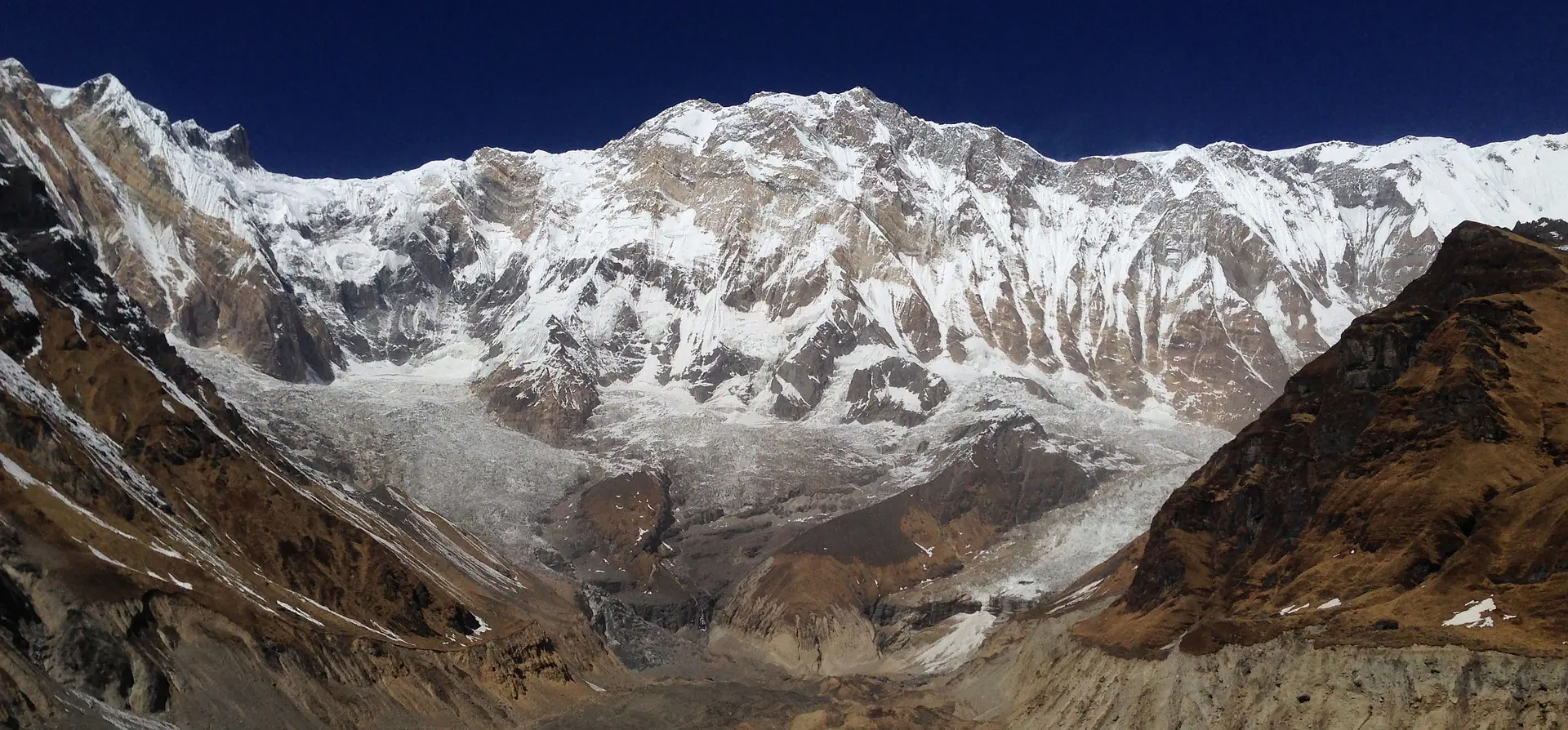
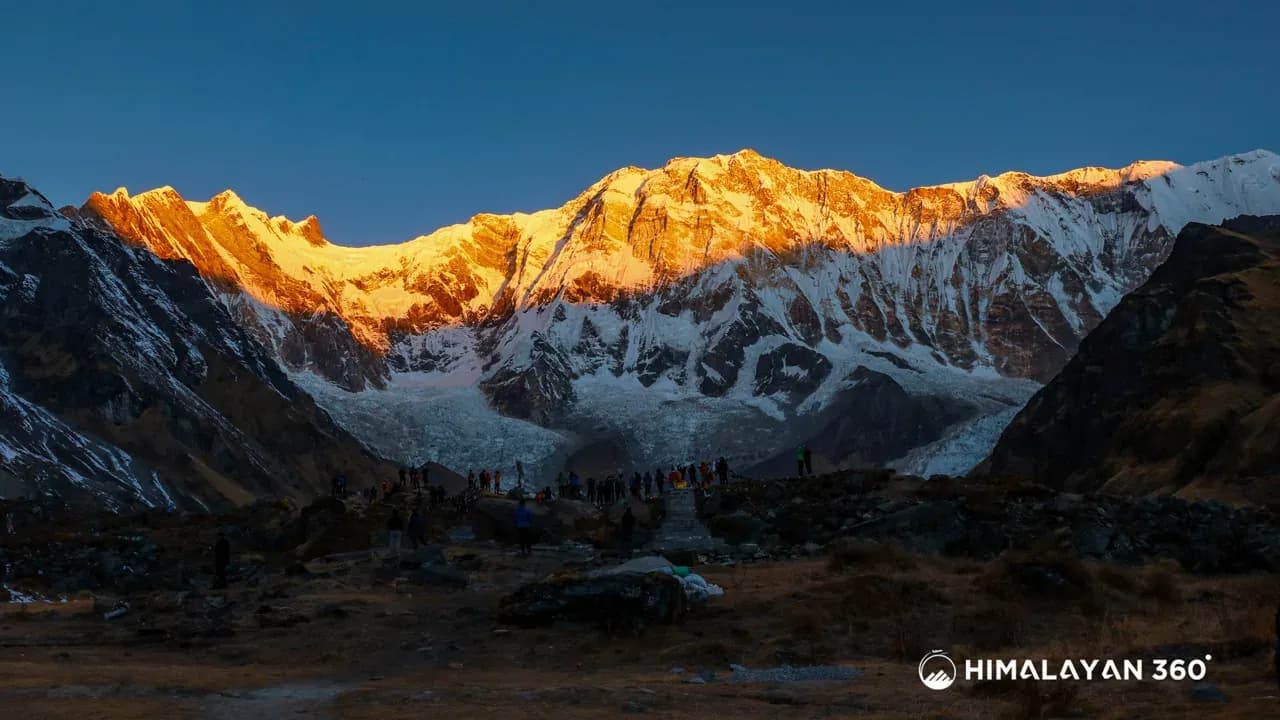
The south face of Annapurna I, 8,091M, from Base Camp.
The height matters for two reasons. It is low enough that most fit people reach it without trouble, and high enough that the last day up, from Deurali at 3,200M, is a 930M climb that some people feel. That day is covered in the altitude section.
Where Is Annapurna Base Camp?
In the Kaski district of central Nepal, north of Pokhara, at the head of the Modi Khola valley. The base camp itself is a cluster of lodges on the moraine at the western edge of the Sanctuary. There is one way in on foot: up the Modi Khola gorge through Chhomrong, Sinuwa, Bamboo, Dovan, Himalaya and Deurali, past Machhapuchhre Base Camp. Every route to ABC joins that trail at Chhomrong, whether you start from Kimche, Nayapul or come over from Poon Hill.
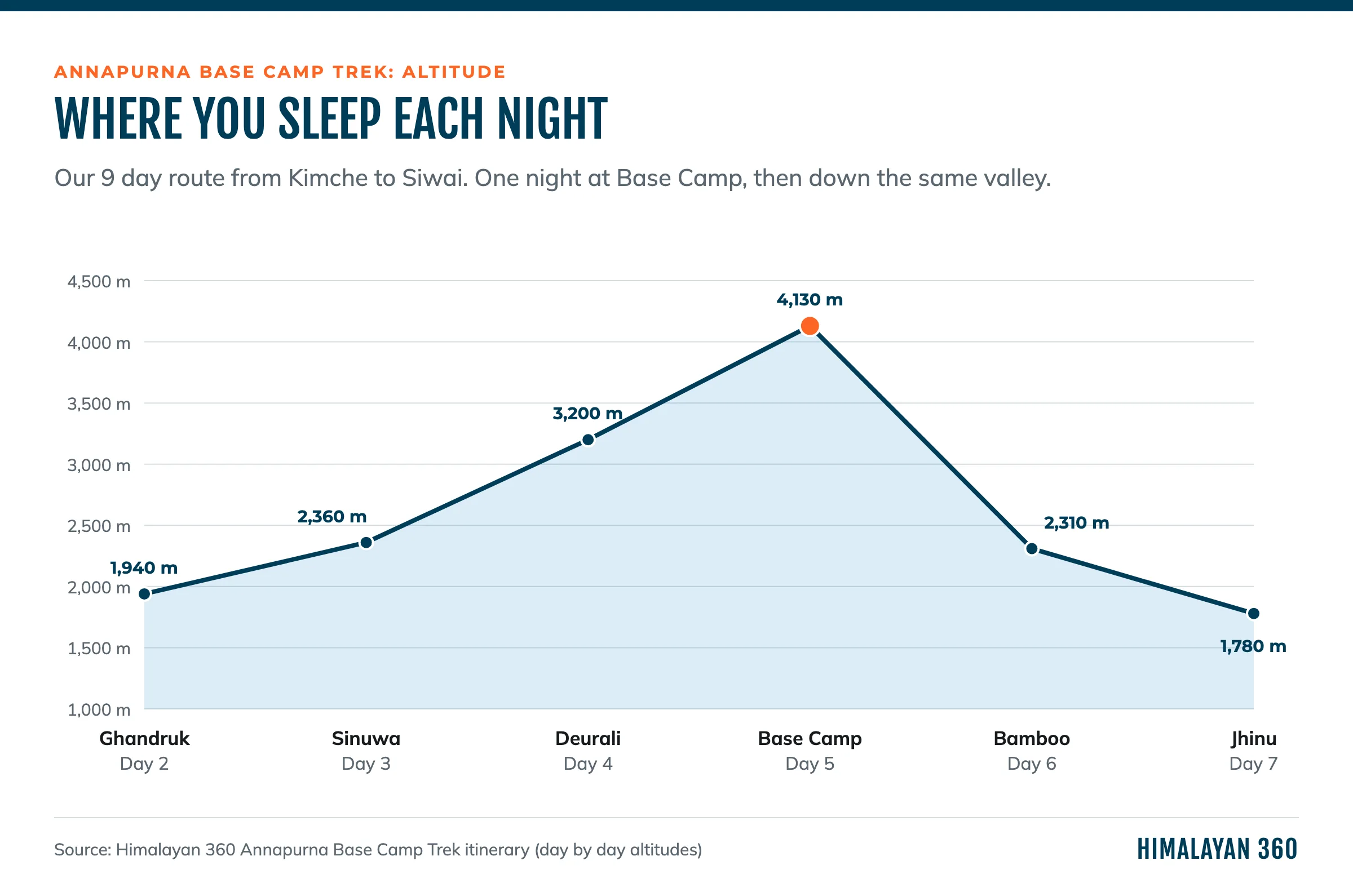
Where you sleep each night on our 9-day route.
Annapurna Sanctuary Trek: The Same Route
The Annapurna Sanctuary trek and the Annapurna Base Camp trek are the same walk. The Sanctuary is the glacial basin; Base Camp is the lodges inside it. Operators use whichever name their customers search for.
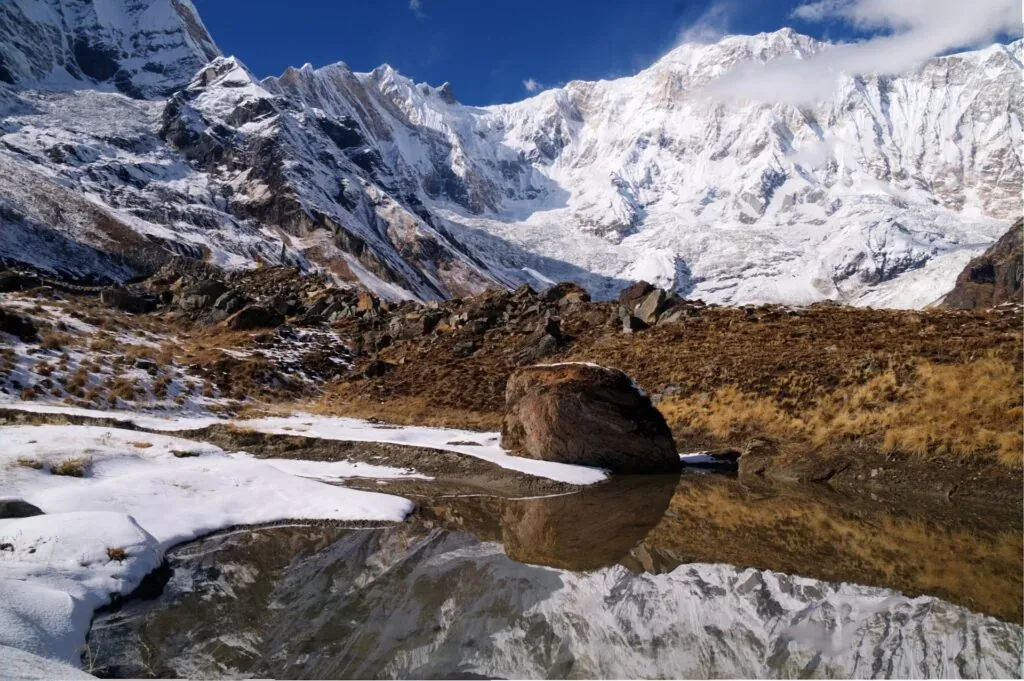
Inside the Annapurna Sanctuary.
The Sanctuary is closed in on almost every side. Annapurna I fills the north, with Annapurna South and Hiunchuli to the west, Gangapurna and Annapurna III to the east and Machhapuchhre (6,993M), the Fishtail, standing over the entrance. The only gap is the Modi Khola gorge, which is why the trail comes in from the south and why the views open all at once above Deurali.
The name fits the way the Gurung villages below see the upper valley, as sacred ground. Lodges above Chhomrong traditionally do not serve meat.
How Hard Is the Annapurna Base Camp Trek?
Moderate. You need no climbing skill, ropes or crampons in the main seasons. What the trek asks for is the ability to walk 6 to 7 hours a day on uneven stone stairs, 6 days out of 7, and sleep one night at 4,130M.
Across the 7 walking days you climb 4,437M and descend 4,547M. Those numbers surprise people who look only at the summit figure. The trail drops into side valleys and climbs out again, so you gain and lose height every day, even on the way down.
The Stairs Day: Ghandruk to Sinuwa
Day 3 is the hardest day of the trek: 13.5KM, 1,544M up, 1,124M down, about 7 hours. It goes over Kimrong Danda to Chhomrong at 2,170M, then drops down a long stone staircase to the Chhomrong Khola bridge and climbs again to Sinuwa.
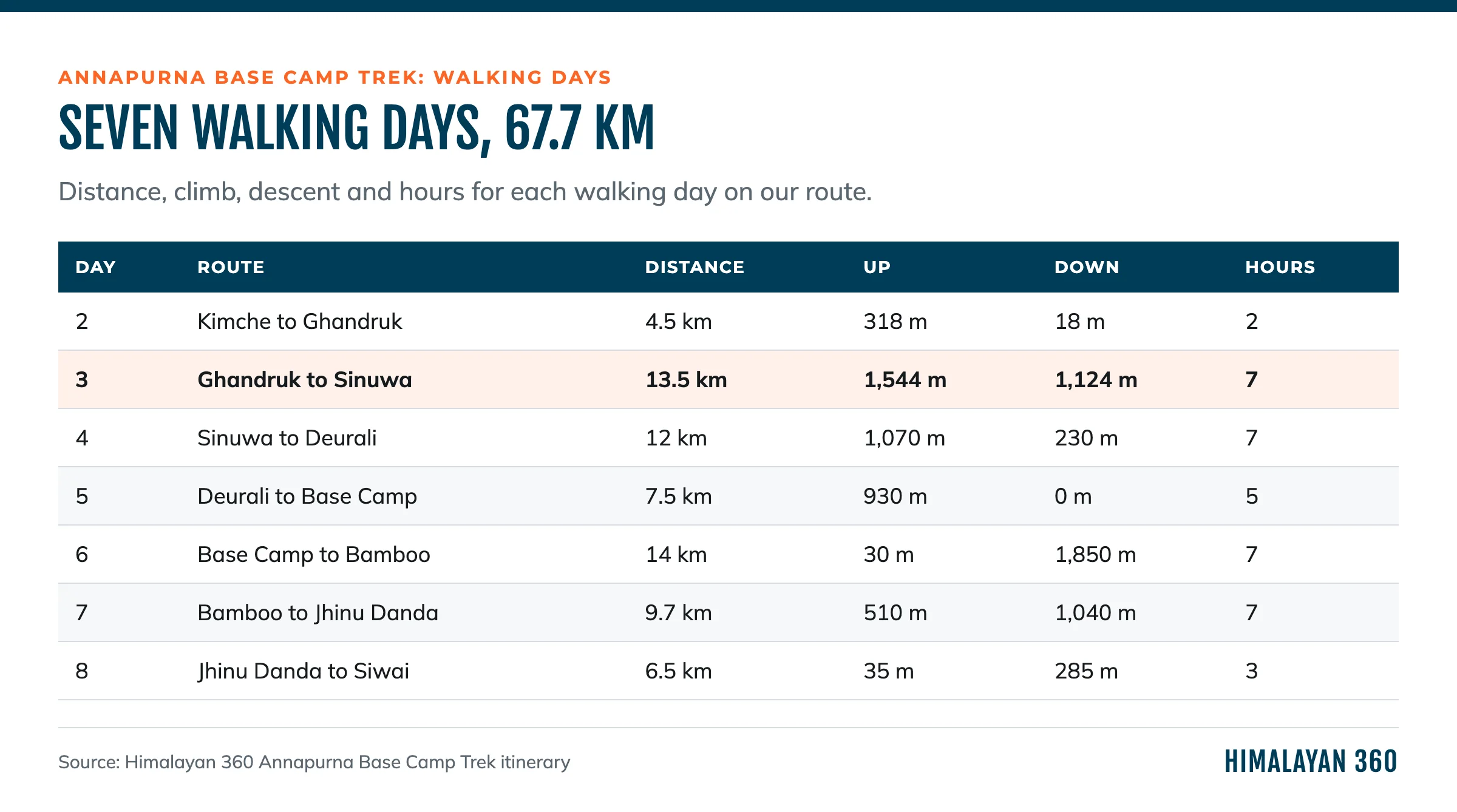
Distance, climb, descent and hours for each walking day on our route.
Two things make the stairs easier. Use trekking poles, mainly on the descents, where they take load off your knees. And go slowly on the way up: the people who struggle on Day 3 are usually the ones who raced the first hour.
Can a Beginner Do the ABC Trek?
Yes. It is one of the most common first treks in Nepal. What helps most:
- Six to eight weeks of training on stairs and hills, with a loaded day pack.
- Boots broken in before you fly. Blisters stop more beginners than altitude does.
- A slower pace on Day 3 and Day 5, the two big climbing days.
- Honest answers to your guide about headaches and sleep from Deurali upwards.
Annapurna Base Camp Trek Itinerary, Day by Day
Our trek is 9 days from Kathmandu to Kathmandu, with 7 walking days. All distances, times and altitudes below are from our itinerary.
| Day | Route | Distance | Time | Sleep |
|---|
| 1 | Kathmandu to Pokhara by tourist bus | 220KM drive | 8 h | Pokhara |
| 2 | Drive to Kimche, walk to Ghandruk | 4.5KM | 2 h | Ghandruk, 1,940M |
| 3 | Ghandruk to Sinuwa via Chhomrong | 13.5KM | 7 h | Sinuwa, 2,360M |
| 4 | Sinuwa to Deurali via Bamboo and Dovan | 12KM | 7 h | Deurali, 3,200M |
| 5 | Deurali to Base Camp via Machhapuchhre Base Camp | 7.5KM | 5 h | Base Camp, 4,130M |
| 6 | Base Camp to Bamboo | 14KM | 7 h | Bamboo, 2,310M |
| 7 | Bamboo to Jhinu Danda, hot springs | 9.7KM | 7 h | Jhinu Danda, 1,780M |
| 8 | Jhinu Danda to Siwai, drive to Pokhara | 6.5KM | 3 h | Pokhara |
| 9 | Pokhara to Kathmandu by tourist bus | 220KM drive | | |
Day 5 is the day most people remember. You leave Deurali early, pass Machhapuchhre Base Camp, and walk the last stretch into the Sanctuary with the whole ring of peaks in view. Get to Base Camp by early afternoon, before the cloud comes up the valley, and be outside again at sunrise on Day 6.
Day 7 ends at the natural hot springs below Jhinu Danda, a short walk down to the river. After six days of stairs, it is the best hour of the trek for most of our groups.
How Many Days Do You Need?
Nine days from Kathmandu is the comfortable standard. The real range is wider:
- 5 days from Pokhara, the fast version, driving further up the road at the start. It suits people who have trekked at altitude before.
- 7 days from Pokhara, our route without the two bus days.
- 11 to 13 days via Poon Hill, adding the Ghorepani sunrise viewpoint before joining the ABC trail at Chhomrong. That is our Annapurna Base Camp Trek with Poon Hill.
Getting to the Trailhead from Pokhara
Pokhara is the start of every ABC trek. From there a vehicle takes you to the road head. We drive to Kimche, above Nayapul, which saves a hot day of walking on a dirt road. Other operators start from Nayapul or drive on to Siwai, which is where we come out on Day 8 by shared jeep. Pokhara itself is a 220KM tourist bus ride from Kathmandu, about 8 hours.
Annapurna Base Camp Trek Map and Route
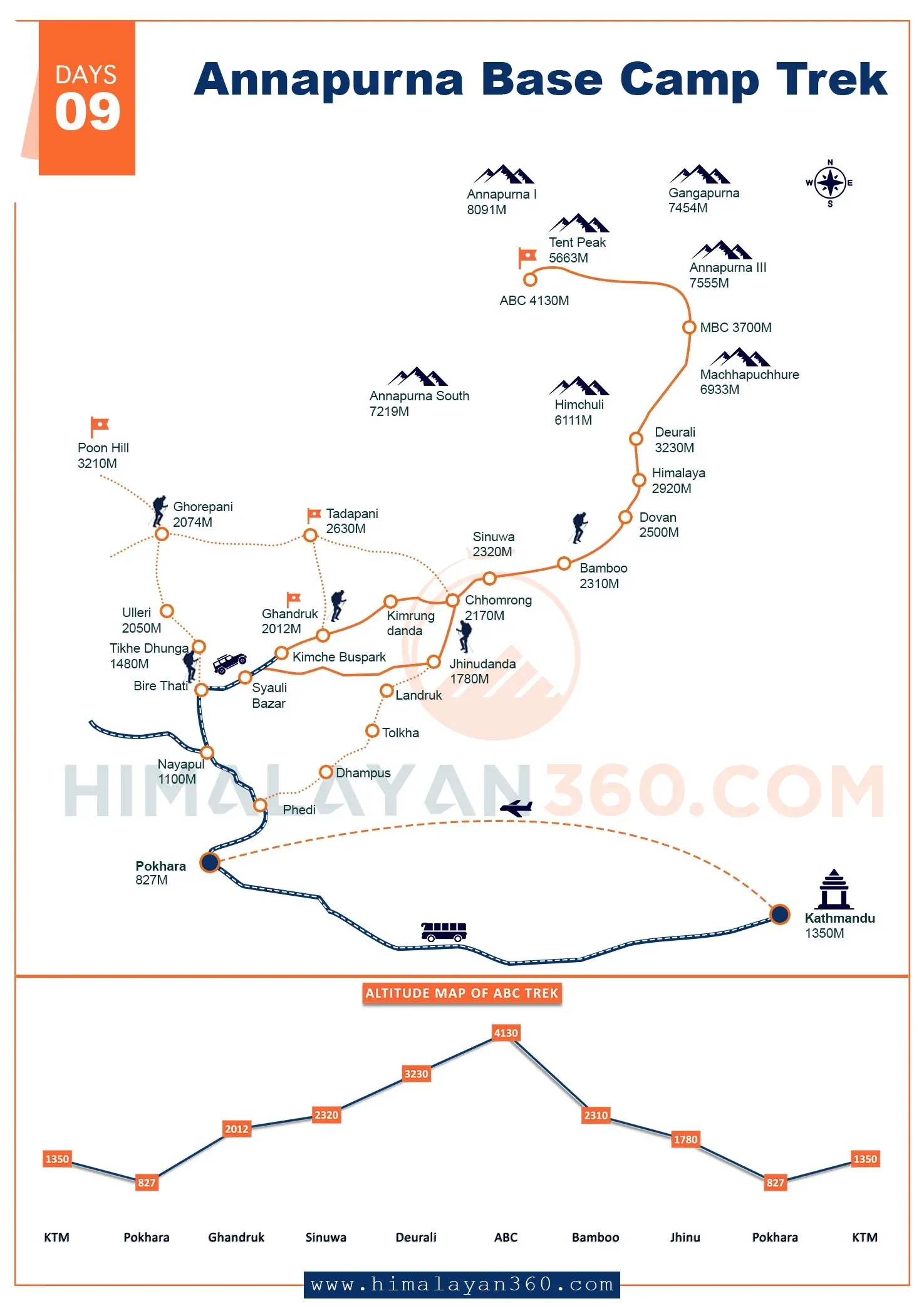
Our 9-day route map. The trail follows the Modi Khola valley north from Chhomrong.
The route is an out and back up one valley. You walk up the Modi Khola from Chhomrong to Base Camp and come down the same trail as far as Chhomrong, then drop to Jhinu Danda instead of returning through Ghandruk. That loop at the bottom means the first and last days see different villages.
Machapuchare Base Camp
Machhapuchhre Base Camp, or MBC, is at 3,700M, the last lodge stop below Annapurna Base Camp, 430M lower. It sits at the entrance to the Sanctuary, directly under Machhapuchhre (6,993M).
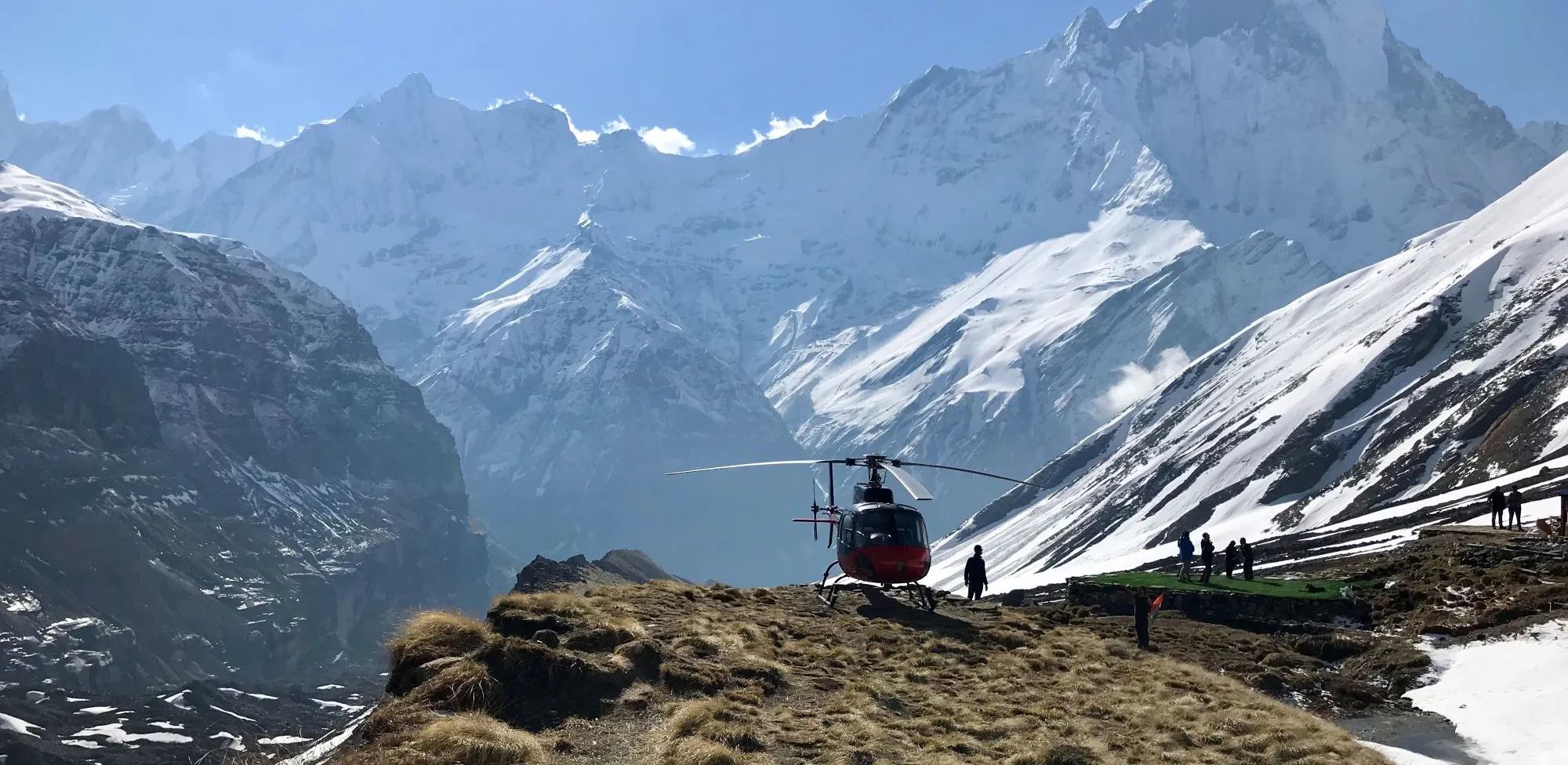
Machhapuchhre Base Camp, where the Sanctuary opens out.
Some groups sleep at MBC instead of going straight from Deurali to ABC. It splits a 930M day into two shorter climbs. If you have felt the altitude at Deurali, that is the better plan, and your guide can make the call on the day. Machhapuchhre itself has never been officially climbed: the mountain is sacred and closed to climbers.
Annapurna Base Camp Trek Permits in 2026
You need two permits: the Annapurna Conservation Area Permit (ACAP) and a TIMS card.
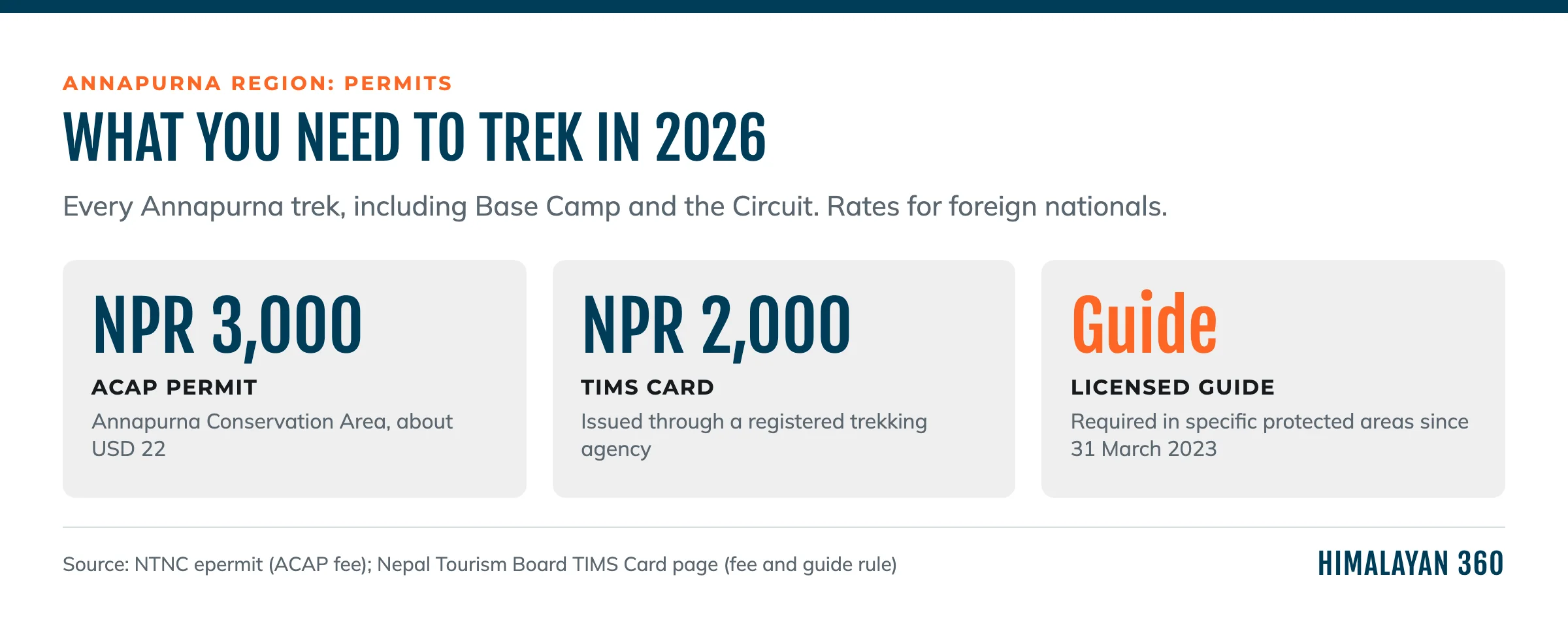
What you need for any Annapurna trek in 2026.
| Permit | Foreign nationals | SAARC nationals | Issued by |
|---|
| ACAP | NPR 3,000 (about USD 22) | NPR 1,000 | National Trust for Nature Conservation |
| TIMS card | NPR 2,000 | NPR 1,000 | Nepal Tourism Board, through a registered agency |
The ACAP fee is set by the National Trust for Nature Conservation, which runs the conservation area. The TIMS fee and the agency rule are on the Nepal Tourism Board TIMS page. Both permits are checked at the ACAP posts on the trail, so keep them in a pocket you can reach. Both are included in our package, and we arrange them in Kathmandu before you leave.
Do You Need a Guide for Annapurna Base Camp?
Yes. A licensed guide has been required since 31 March 2023. The Nepal Tourism Board's revised TIMS provision says that "specific Protected Areas of Nepal need trekker to be accompanied by licensed trekking guide and carry a trekking agency issued TIMS Card". Its list for the Annapurna region names the Poon Hill-ABC Trek, along with the Annapurna Circuit, Nar Phu, Khopra and Mardi Himal.
That means a solo trip is still possible, but not an unguided one. You can trek with just you and a guide. What you cannot do any more is buy a TIMS card yourself and walk in alone.
A guide on this trek earns their place in three ways that have nothing to do with the rule. They decide whether to stop at MBC or push on to ABC based on how you look at Deurali. They know which lodges have rooms in October, when the upper valley fills. And they know the avalanche paths above Himalaya and when to avoid them.
A porter is separate and optional. Our package covers the guide, and a porter can be added at one porter for two trekkers.
How Much Does the Annapurna Base Camp Trek Cost?
Our 9-day Annapurna Base Camp trek is USD 666 to 820 per person, depending on how many people are in your group.
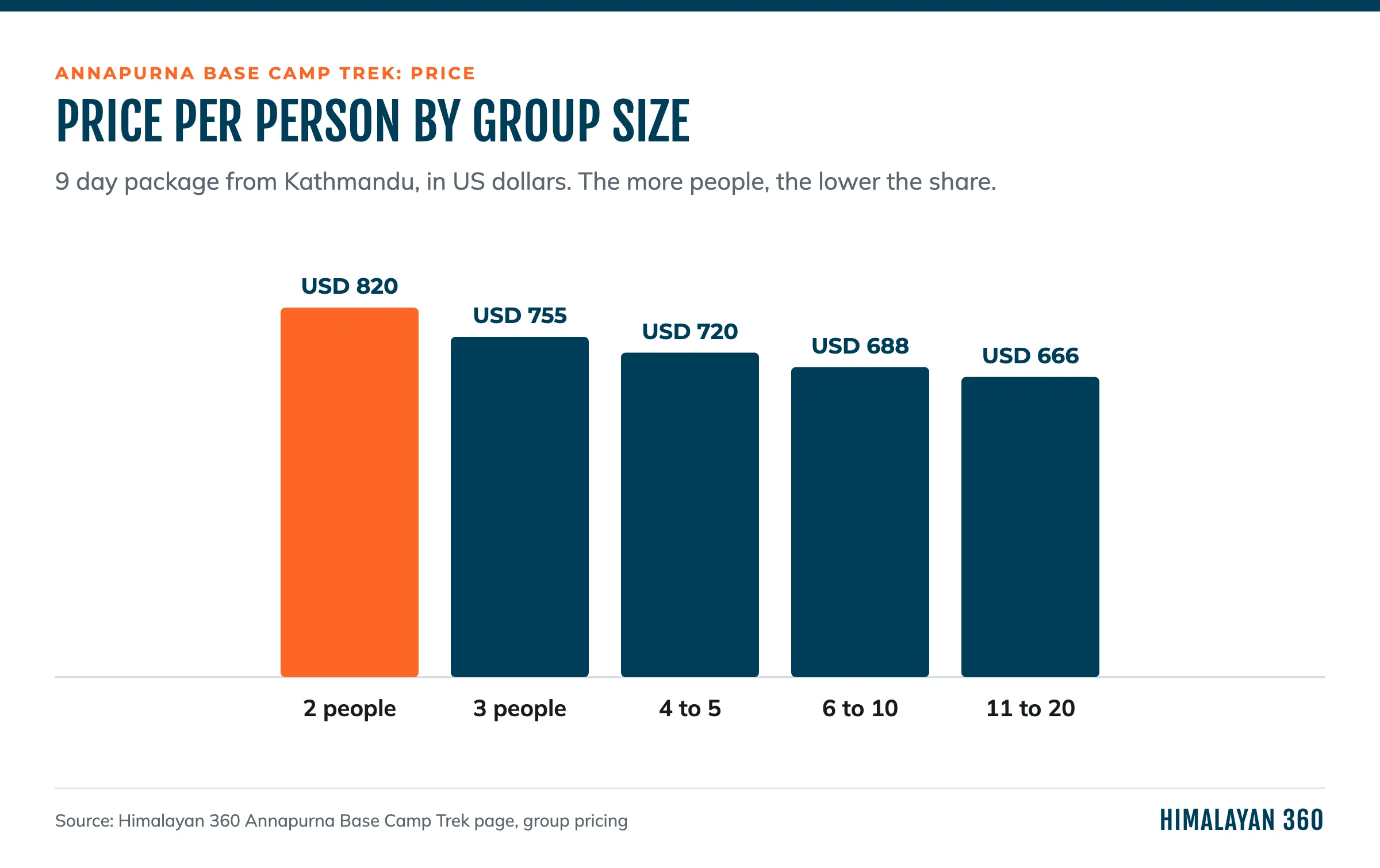
Price per person from Kathmandu, by group size.
Included: the bus to Pokhara and back, the drive to Kimche and the jeep from Siwai, 2 nights in Pokhara and 1 in Kathmandu in 3-star hotels, 6 nights in teahouses, 9 breakfasts, 7 lunches and 7 dinners, a licensed guide, the ACAP and TIMS fees, taxes and a medical kit.
Not included: travel insurance (compulsory), a porter, international flights, drinks, boiled water, hot showers, wifi and charging on the trail, and tips. Prices on the trail rise with altitude, because everything above Chhomrong is carried up by porters or mules, so keep more cash for the upper valley than for the lower one. There are no ATMs past the trailhead villages; take Nepali rupees from Pokhara.
Full prices and dates are on the Annapurna Base Camp Trek page.
Best Time for the Annapurna Base Camp Trek
October and November give the clearest views. March to May is the second season, with rhododendron forest in flower below Sinuwa. Our trip page lists February to May and September to December as the season.
Autumn: September to November
The monsoon clears in late September and the mountains are sharpest through October and November. This is also the busiest time, so the lodges at Deurali, MBC and ABC fill up early. Book ahead and expect to share rooms with other groups in the upper valley.
Spring: March to May
April is the pick of spring: longer days, warmer nights and the forest red with rhododendron. Haze builds through May and afternoon cloud comes up the valley earlier, so plan to be at Base Camp before lunch.
Winter and Monsoon
Winter, December to February, is quiet and clear, but nights at ABC are well below freezing and snow can close the trail above Deurali after a storm. Monsoon, June to August, brings leeches, slippery stairs and cloud that can hide the peaks for days. Both are possible with the right gear and a flexible day, but neither is where I would send a first-time trekker.
Annapurna Base Camp Weather and Temperature
Days are mild and nights are cold, and the difference grows the higher you go. In the main seasons you walk in a t-shirt in the lower valley, then need a down jacket from Deurali upwards. Nights at Base Camp are below freezing in every month outside the monsoon.
The pattern is the same most days. Mornings are clear. Cloud rises up the Modi Khola gorge from late morning, and the upper valley is often in mist by mid afternoon. That is why the walking days start early and why sunrise at Base Camp is the moment to plan around.
Avalanche Risk Between Deurali and MBC
The stretch between Himalaya, Deurali and Machhapuchhre Base Camp sits under steep slopes that release avalanches after heavy snow. In January 2020 an avalanche on this trail left four South Korean trekkers and three Nepali guides missing, as the BBC reported.
In autumn and spring the risk is low and the trail is busy. It rises after any heavy snowfall, mainly in winter and early spring. ACAP and lodge owners close the trail when conditions are bad, and the guides on the trail share the news fast. If your guide holds you at Deurali or Himalaya for a day, that is the reason, and it is the right call.
Altitude Sickness on the ABC Trek
Most people reach Base Camp without serious altitude problems, but Day 5 is the day to watch. It climbs 930M from Deurali at 3,200M to Base Camp at 4,130M, which is more than the usual guideline of 300 to 500M of sleeping gain a day above 3,000M.
What helps:
- Stop at MBC (3,700M) instead of going straight to ABC if you have a headache at Deurali.
- Drink well and walk slowly on the last climb into the Sanctuary.
- Tell your guide about headaches, nausea or bad sleep. They can only act on what they know.
- Go down if symptoms get worse. On this trek, descent is easy: Bamboo is 1,820M below Base Camp and a day away.
Our full guide to preventing altitude sickness covers the symptoms and the rules for every trek we run.
Teahouses, Food and Wifi on the ABC Trek
You sleep in teahouses every night on the trail: simple lodges with twin rooms, shared toilets and a heated dining room. Rooms are unheated, so the dining room stove is where everyone spends the evening.
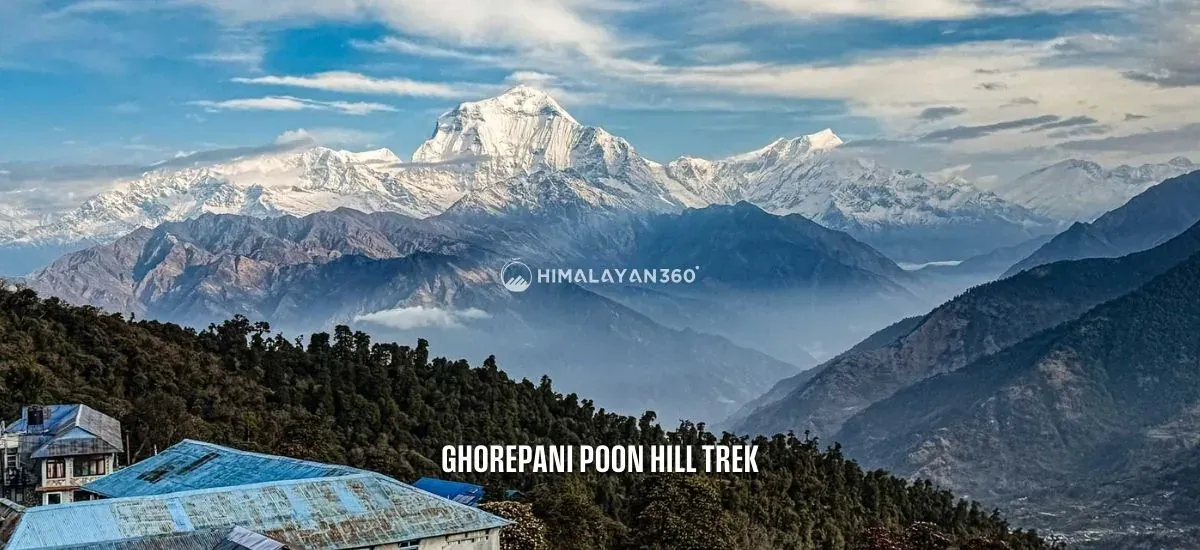
Teahouses at Ghorepani, on the Poon Hill version of the trek.
- Food. Dal bhat, the rice and lentil set meal, is on every menu and comes with refills. Noodles, pasta, potatoes, eggs and pancakes are common. Above Chhomrong, lodges traditionally do not serve meat.
- Water. Buy boiled water at the lodges or use purification tablets. Plastic bottles are discouraged in the conservation area.
- Showers. Hot showers are paid extras and get scarcer and more expensive above Bamboo.
- Wifi and charging. Most lodges sell wifi and charging by the hour or by the device. Both get slower and dearer higher up. A power bank saves money.
- Mobile signal. Patchy above Sinuwa. Do not count on it in the Sanctuary.
What to Pack for Annapurna Base Camp
Pack for a mild lower valley and a freezing night at 4,130M. Keep your bag light: porters carry up to two trekkers' bags, and on our package you carry your own unless you add one.
Packing Checklist
- Broken-in trekking boots and camp shoes
- Trekking poles, mainly for the stairs going down
- A down jacket and a fleece
- A waterproof shell, jacket and trousers
- Thermal base layers for the nights
- A sleeping bag rated to about minus 10°C, or rent one in Pokhara
- Sun hat, warm hat, gloves and sunglasses
- Sunscreen and lip balm
- Water bottles and purification tablets
- A headlamp for sunrise at Base Camp
- A small first aid kit and blister plasters
- Cash in Nepali rupees for the trail
- A power bank
- Swimwear for the Jhinu Danda hot springs
Annapurna Base Camp vs Everest Base Camp
Annapurna Base Camp is shorter, lower and cheaper. Everest Base Camp is higher and better known. ABC tops out at 4,130M with one night above 4,000M. Everest Base Camp is at 5,364M, and that trek spends five nights above 4,000M with two acclimatisation days on the way up.
What ABC has that Everest does not is the Sanctuary itself: a full ring of peaks around you at Base Camp, not a view of one mountain from a ridge. What it lacks is a single famous summit. If you have two weeks and want height, go to Everest. If you have nine days and want the most mountain for the least altitude risk, ABC is the better trek.
If you are choosing between Annapurna and Langtang instead, our Langtang Valley vs Annapurna Base Camp comparison covers it. For a shorter trek in the same region, see the Mardi Himal trek guide.
Trek Annapurna Base Camp With Us
Our Annapurna Base Camp Trek is the 9-day route in this guide, from Kathmandu, with a licensed guide, permits, teahouses and transport included. We also run it with Poon Hill, as an Annapurna Base Camp Yoga Trek, as a one-day Annapurna Base Camp Heli Tour from Pokhara, and to the quieter Annapurna North Base Camp. Every trek in the Annapurna region we run is on one page.
Ask us about dates, and we will tell you how busy the upper valley will be in your week before you book.
 Trek
 By air
 Pilgrimage
 Festivals
 Wildlife
 Luxury
 Yoga
 Food
 Heritage
