A guided Manaslu Circuit Trek costs USD 920 to 1,430 per person. By the time you fly home you will have spent about USD 1,500 to 2,200, and the difference is the things that sit outside the package: a porter, your insurance, tips, the visa and what you buy on the trail. Everything below is priced so you can add up your own trip before you commit to it.
This page covers Manaslu Circuit pricing and nothing else. If you want the permit rules, how hard it is, the day by day route or the best time to go, all of that is in the Manaslu Circuit Trek guide.
Manaslu Circuit Trek Cost at a Glance
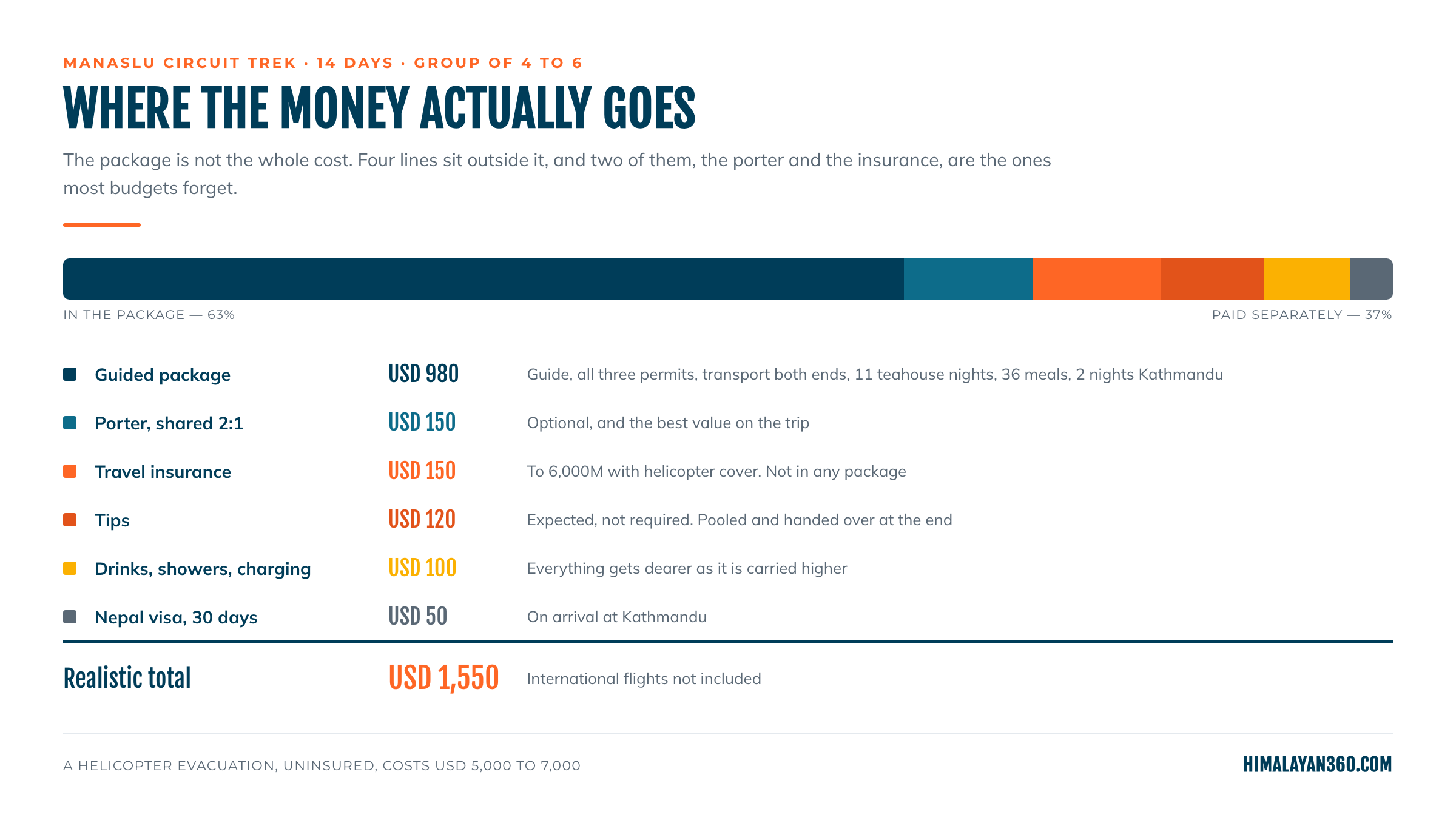
| Item | Cost per person |
|---|
| Guided package, group of 4 to 6 | USD 980 |
| Guided package, solo private | USD 1,430 |
| Permits (MRAP, MCAP, ACAP) | USD 144 Sep to Nov, USD 119 Dec to Aug |
| Porter, shared 2:1 | USD 150 over the trek |
| Travel insurance to 6,000M | USD 100 to 200 |
| Tips, guide and porter | USD 100 to 150 |
| Nepal visa, 30 days | USD 50 |
| Drinks, charging, hot showers | USD 80 to 120 |
| Realistic all-in, group departure | USD 1,500 to 1,650 |
| Realistic all-in, solo private | USD 2,100 to 2,250 |
None of the figures below include your flights to Nepal.
Why the Manaslu Circuit Costs More Than Other Nepal Treks
You can walk the Annapurna Circuit for a few hundred dollars. You cannot do that here, and it is not because operators are charging more. Four costs are fixed by law or by geography before anyone quotes you anything.
- A licensed guide is compulsory. Not recommended, required, for every trekker between Jagat and Dharapani. At USD 25 to 50 a day that is the largest single line in any package, and there is no version of this trek without it.
- The permits are agency filed. You cannot walk into an office and buy them, so there is always a registered company in the transaction taking a service charge. On Annapurna you can buy your own ACAP and go.
- There is no road in the middle. Every meal, sheet of tin and gas cylinder above Machha Khola arrived on a back or a mule, and the prices in the teahouses carry that. A bottle of water that costs USD 1 at the trailhead costs USD 4 near the pass.
- The trailhead is 8 to 10 hours away. Two long vehicle days, and a jeep past Arughat because nothing else gets through.
None of that scales down for one person. The guide costs the same whether they walk with one trekker or seven, which is why the price per head falls so sharply as a group fills and why solo is the most expensive way to do it.
What you are not paying for is the mountain. Permits are USD 144 of a USD 1,550 trip. The rest is the guide, the vehicle and the fact that nobody can drive to Samagaun.
What a Guided Package Costs
You cannot walk this route without a licensed guide and permits filed by a registered agency, so a package is not optional the way it is on the Annapurna Circuit. What varies is how many people split it.
Our published prices for the 14 day Manaslu Circuit Trek:
| Group size | Price per person |
|---|
| 1 | USD 1,430 |
| 2 to 3 | USD 1,080 |
| 4 to 6 | USD 980 |
| 7 to 12 | USD 975 |
| 13 to 20 | USD 935 |
| 21 to 30 | USD 920 |
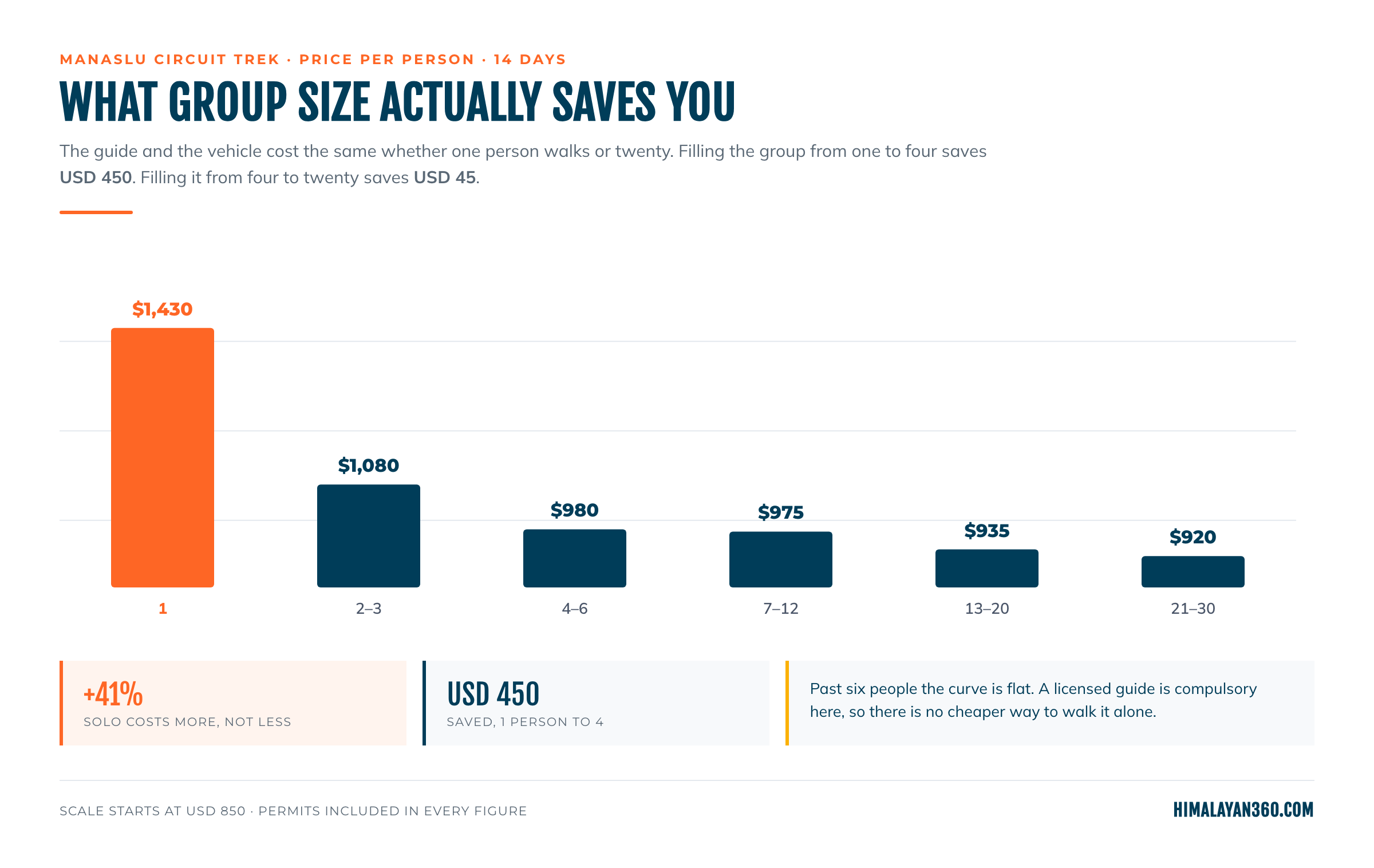
The curve flattens after six people because the fixed costs, the guide and the vehicle, are already spread. Going from one trekker to four saves USD 450. Going from four to twenty saves USD 45.
What Is In the Price
- All three permits, filed for you
- A government licensed, English speaking trek leader
- Airport transfers, and the drives to Machha Khola and back from Dharapani
- Two nights in a three star Kathmandu hotel, sharing
- Eleven teahouse nights on the trail
- Thirteen breakfasts, twelve lunches, eleven dinners
- Government and local taxes, and our service charge
- Luggage storage in Kathmandu, and a duffel bag for the trek
What Is Not
The porter, which is the one people miss. Also the Nepal visa, travel insurance, drinks, hot showers, charging, wifi, tips, and any extra night in Kathmandu caused by an early arrival or an early exit from the trail.
Permits: USD 144 or USD 119
| Permit | Sep to Nov | Dec to Aug |
|---|
| Manaslu Restricted Area Permit (MRAP) | USD 100 first 7 days, then USD 15 per day | USD 75 first 7 days, then USD 10 per day |
| Manaslu Conservation Area Permit (MCAP) | NPR 3,000 (about USD 22) | NPR 3,000 |
| Annapurna Conservation Area Permit (ACAP) | NPR 3,000 (about USD 22) | NPR 3,000 |
| Total | About USD 144 | About USD 119 |
The conservation fees are set and paid in rupees. The permit desks will not take dollars, so bring rupees or let us handle it. SAARC nationals pay NPR 1,000 for each of the two conservation permits.
All three are in our package price, so you are not paying this on top.
Guide and Porter
A licensed guide is compulsory in the restricted area. Hired independently the going rate is USD 25 to 50 per day, and that is the single largest line in any package. Ours is included.
A porter is optional and not in our price. The rate is USD 20 to 25 per day, and porters normally work 2:1, one between two trekkers, so a fourteen day trek costs roughly USD 150 per trekker once shared.
If you take one optional thing, take this. Carrying five kilos instead of twelve changes the last two hours of every day, and the drop from Larkya La to Bhimtang is 1,400M in a single afternoon.
Getting to the Trailhead
Machha Khola is about 160KM northwest of Kathmandu and the drive takes 8 to 10 hours. This is in our package, but here is what it costs if you are arranging it yourself.
- Local bus. USD 15 to 30 per person each way, about 10 hours, leaving Gongabu between 6:00 and 7:00 AM.
- Private jeep. USD 180 to 250 per vehicle each way, 7 to 8 hours, hotel pickup. A 4WD carries 6 to 7 people, so split between a group it is often cheaper per head than it looks.
Past Arughat the road stops being a road, so it is a jeep or nothing.
Teahouses, Meals and What You Spend on the Trail
| Item | Typical price |
|---|
| Teahouse room, twin share | USD 5 to 10 per night |
| Meal | USD 5 to 10 |
| Tea or coffee | USD 2.50 to 4 |
| Hot shower | USD 3 to 5 |
| Device charging | USD 2 to 4 per hour |
| Wi-Fi | USD 3 to 5 |
| Bottled water | USD 1 to 4, rising with altitude |
Your room and all your meals are in the package. Drinks, hot showers, charging and wifi are not, and that is what your daily spending money is for. Prices climb with the trail, because everything up there was carried up on somebody's back.
Budget USD 80 to 120 for the trek. Carrying a filter or purification tablets instead of buying bottled water saves most of that on its own.
Travel Insurance, and Why You Cannot Skip It
Insurance is not in our package, and we will not take you without it. Budget USD 100 to 200 for a two week policy.
The premium is not really the point. This is: if something goes wrong past Samagaun, the only way out is a helicopter, and that costs USD 5,000 to 7,000 to Kathmandu. There is no road up there. Nobody can drive to you.
Two things to check on whatever policy you buy:
- The altitude limit. Cheap policies sold for Nepal typically cap at 4,000M. Larkya La is 5,106M. A policy that stops at 4,000M does not cover the pass, which is the one day you would actually need it. You want cover to 6,000M.
- How the rescue is paid for. Most operators want payment or a guarantee before they lift. Policies that reimburse you afterwards still work, but somebody has to make the call and stand behind the cost first. Know which yours is before you fly.
We do not sell insurance and we will not push you towards a particular company. We would just rather you knew the number before you decided it was optional.
Season Changes What You Pay
Season is a cost decision here, not only a weather one. Three things move.
| Peak (Sep to Nov, Mar to May) | Off peak (Dec to Feb, Jun to Aug) |
|---|
| Restricted Area Permit | USD 100 for 7 days, then USD 15 per day | USD 75 for 7 days, then USD 10 per day |
| Group departures | Run regularly, easy to fill and split | Rare, so a private trek is often the only option |
| Dharamsala beds | Booked out in October and April | Available, though some lodges close |
The permit saving is USD 25, and that is the small number. The big one is group size. Walk in a month when departures are actually running and you share a guide and a jeep with five other people instead of paying for both yourself. That is the USD 450 gap between our solo and group prices.
So the cheapest way to walk this trek is not the off season. It is a shoulder week inside the season, late September, early December or early March, when departures are still going out but the trail and the lodges are not full.
Booking off season to save the USD 25 permit and then paying USD 450 for a private trek because nothing else is running is the most common way people spend more by trying to spend less.
Trekking Solo Costs More, Not Less
Since March 2026 a single trekker can be issued the restricted-area permit, so solo is genuinely possible. It is also the most expensive way to walk this trail.
The guide wage, the vehicle to Machha Khola and back, and the agency's fixed costs stop being split. Our own prices show it exactly: USD 1,430 solo against USD 980 in a group of four to six. The permits cost the same either way.
If you want the trail to yourself rather than the paperwork to yourself, a shoulder week in late September or early March does more for that than paying USD 450 to walk alone. What the rules mean day to day is in the Manaslu Circuit Trek solo guide.
What It Adds Up To
Here is the whole thing, added up, for a 14 day trek in autumn. Flights to Nepal are not included.
| Group of 4 to 6 | Pair | Solo private |
|---|
| Guided package | USD 980 | USD 1,080 | USD 1,430 |
| Porter, shared 2:1 | 150 | 150 | 300 |
| Travel insurance | 150 | 150 | 150 |
| Tips | 120 | 120 | 150 |
| Nepal visa, 30 days | 50 | 50 | 50 |
| Drinks, showers, charging | 100 | 100 | 100 |
| Total | USD 1,550 | USD 1,650 | USD 2,180 |
Permits are inside the package figure in all three columns. A solo trekker pays 41 percent more than someone in a group of four, and every dollar of that difference is the guide and the vehicle.
Six Ways to Spend Less
- Fill the group. One to four people is a USD 450 saving. It is the only lever on this list worth hundreds.
- Walk in the shoulder weeks. Late September, early December and early March. The off-peak permit is USD 25 cheaper and the trail is quieter.
- Carry water purification. Bottled water rises to USD 4 near the pass. Tablets or a filter cost less than three days of buying it.
- Rent the big gear in Thamel. A down jacket and a sub-zero sleeping bag rent for a few dollars a day and are not worth buying for one trek.
- Share the porter. 2:1 is the standard ratio and halves the largest optional line.
- Skip the extra Kathmandu nights. Arrive on the day the trip starts if your flight allows it.
You will notice the porter, the insurance and the acclimatisation days are not on that list. Cutting those saves a little and can cost you a great deal.
Book the Manaslu Circuit Trek
Our Manaslu Circuit Trek runs as a 14 day guided departure from Kathmandu, from USD 920 per person, with all three permits, a licensed guide, transport at both ends, teahouse accommodation and 36 meals included. The same route also runs as a 13 Days Manaslu Circuit Trek from USD 890 and a 12 Days Manaslu Circuit Trek from USD 845, both Kathmandu to Kathmandu by bus and jeep, without the hotel nights.
Make an enquiry with your dates and group size and we will send the real number for your trip, not a range.
More on the trek: trekking solo · Manaslu region treks
 Trek
Trek By air
 Pilgrimage
 Festivals
 Wildlife
 Luxury
 Yoga
Yoga Food
Food Heritage