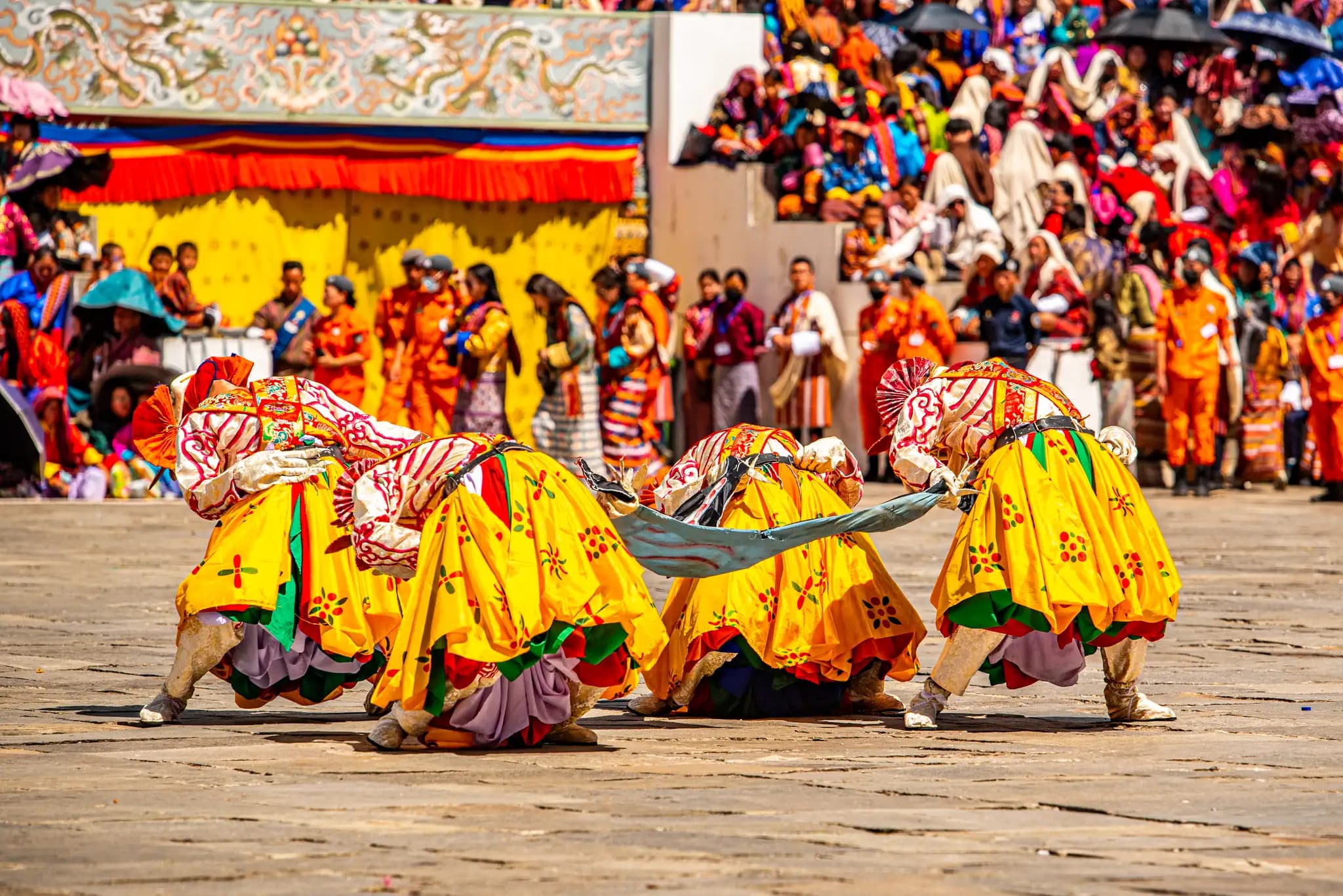
Bhutan's festivals are tshechus: religious festivals held in dzong and temple courtyards, where monks and laymen perform masked cham dances in honour of Guru Rinpoche. The two biggest in 2027 are the Paro Tshechu, expected from 18 to 22 March, and the Thimphu Tshechu, expected from 10 to 12 October. Dates follow the Bhutanese lunar calendar and move each year.
Punakha opens the year with its Drubchen and Tshechu in February. The Black-necked Crane Festival in the Phobjikha valley falls on 11 November every year.
Bhutan Festival Calendar 2027
Bhutan's 2027 festival calendar starts with the Punakha Drubchen in February and ends with the Druk Wangyel Tshechu at Dochula in December. Most tshechus fall in spring and autumn, with a second cluster in winter. These are the festivals on or near our tour routes:
| Festival | Place | Expected dates, 2027 |
|---|
| Punakha Drubchen | Punakha Dzong | 13 to 15 February |
| Punakha Tshechu | Punakha Dzong | 16 to 18 February |
| Paro Tshechu | Rinpung Dzong, Paro | 18 to 22 March |
| Ura Yakchoe | Ura Lhakhang, Bumthang | 18 to 22 April |
| Rhododendron Festival | Lamperi Botanical Park, Thimphu | 22 to 23 April |
| Nimalung Tshechu | Nimalung Dratshang, Bumthang | 12 to 14 June |
| Kurjey Tshechu | Kurjey Lhakhang, Bumthang | 14 June |
| Thimphu Drubchen | Tashichho Dzong, Thimphu | 5 October |
| Wangdue Tshechu | Wangdue Phodrang | 8 to 10 October |
| Thimphu Tshechu | Tashichho Dzong, Thimphu | 10 to 12 October |
| Gangtey Tshechu | Gangtey Goenpa, Phobjikha | 13 to 15 October |
| Jakar Tshechu | Jakar Dzong, Bumthang | 6 to 9 November |
| Black-necked Crane Festival | Gangtey Goenpa, Phobjikha | 11 November |
| Druk Wangyel Tshechu | Dochula | 13 December |
Tentative dates from the 2027 festival list of the Association of Bhutanese Tour Operators and the Department of Tourism, updated 14 February 2025. Tshechu dates follow the Bhutanese lunar calendar and can move, so confirm them with us before you book flights. The Black-necked Crane Festival and the Druk Wangyel Tshechu are held on the same date every year.
Paro Tshechu 2027
The Paro Tshechu is expected from 18 to 22 March 2027 at Rinpung Dzong in Paro. In 2026 it ran from 29 March to 2 April. It falls in the second month of the Bhutanese lunar calendar, which lands in spring.
For five days, monks and laymen perform cham in the courtyard of the dzong. Before dawn on the last morning, the thongdrel, a giant embroidered scroll, is unveiled on the wall of the dzong. It is shown for only a few hours and rolled away before the sun reaches it.
- Dance days: the dances start around 9 am. Be seated by about 8:30 for a spot at the shaded edge of the courtyard.
- Thongdrel morning: the unveiling starts in the dark, around 3 to 4 am. Bring a headlamp and a warm layer.
- Hotels and flights: Paro has one small airport and a limited number of hotels, and festival week sells out. Book four to six months ahead.
Our Paro Tshechu Festival Tour is built around these dates.
Thimphu Tshechu 2027
The Thimphu Tshechu is expected from 10 to 12 October 2027 at Tashichho Dzong in Thimphu, the capital. It draws the largest crowds of any festival in Bhutan. The Thimphu Drubchen is held at the same dzong first, on 5 October.
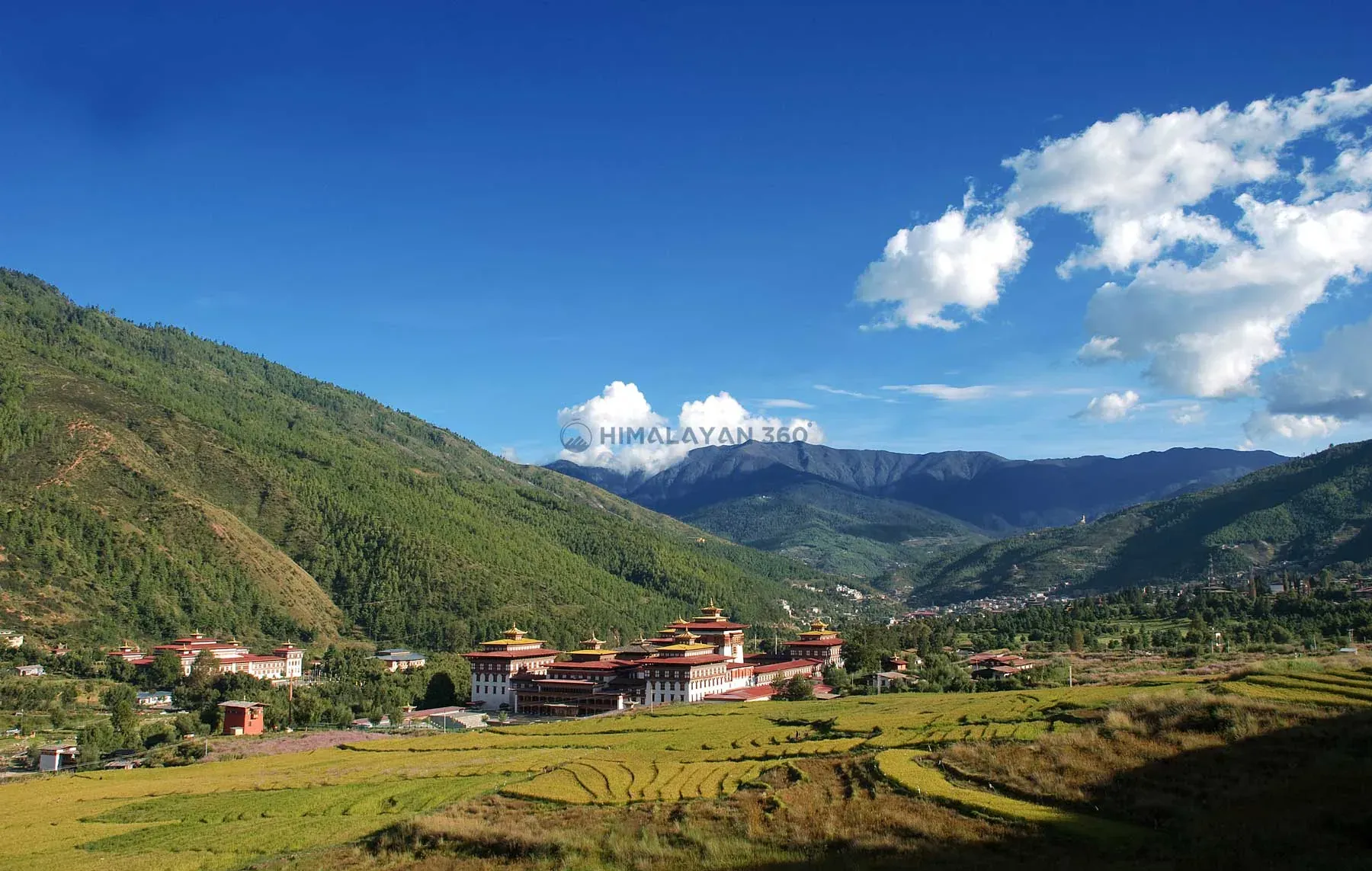
Tashichho Dzong in the Thimphu valley, where the Thimphu Tshechu is held.
October is one of the clearest months in western Bhutan. Paro averages 21 °C by day and 9 °C at night in October, with rain on about four days.
Bhutan's Sustainable Development Fee is USD 100 per person per night, under a discount that was due to end on 31 August 2027. Kuensel and Daily Bhutan report it extended to 31 December 2029, while the Department of Tourism's announcements page still shows the 2027 date. Confirm the rate before you book for the October 2027 festival. The fee is explained on Bhutan Tourist Fee.
Punakha Drubchen and Tshechu 2027
The Punakha Drubchen is expected from 13 to 15 February 2027 and the Punakha Tshechu from 16 to 18 February, both at Punakha Dzong.
The Drubchen, listed as the Punakha Dromchoe on the official calendar, re-creates the battle of 1649 in which the Bhutanese defeated a Tibetan army. Men dressed as pazaps, the traditional militia, perform it over three days, and it ends with the sacred substances of the ritual immersed in the Mo Chhu river. A Journal of Bhutan Studies paper by Sonam Kinga dates the first Drubchen to 1649, from a biography of Zhabdrung Ngawang Namgyal; other accounts give different years. The Punakha Tshechu follows it with three days of masked dances.
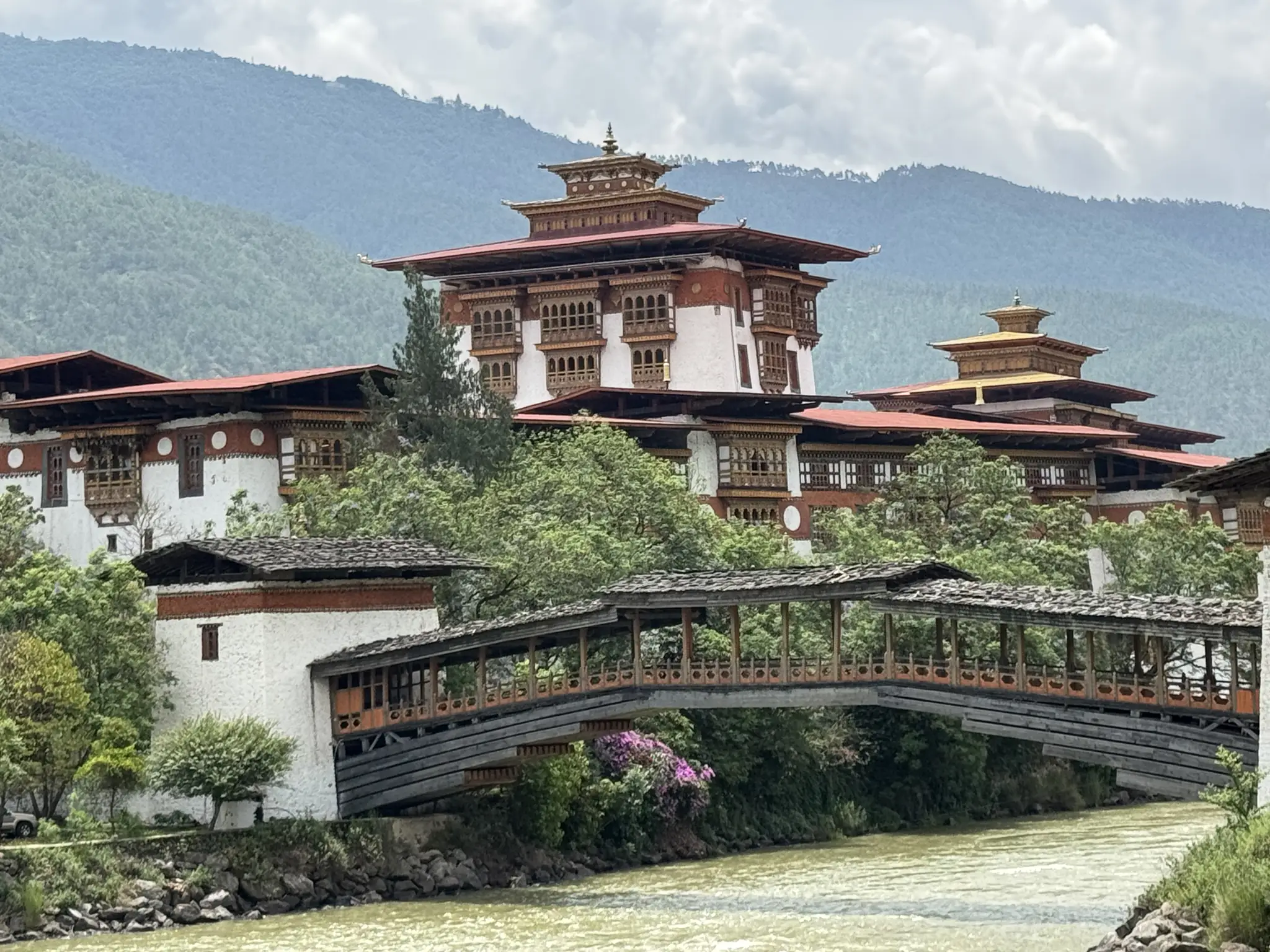
Punakha Dzong, where the Drubchen and Tshechu are held in February.
Punakha Dzong stands where the Pho Chhu and Mo Chhu rivers meet. Zhabdrung Ngawang Namgyal built it between 1639 and 1640, according to Sonam Kinga in the Journal of Bhutan Studies. It was the capital for over 300 years, and every King of Bhutan has been crowned there since 1907. Punakha sits lower than Paro and is warmer in winter. In February, Paro averages 15 °C by day and 1 °C at night.
Black-Necked Crane Festival
The Black-necked Crane Festival is held on 11 November every year in the courtyard of Gangtey Goenpa in the Phobjikha valley. It is a one-day festival that celebrates the arrival of the black-necked cranes for the winter.
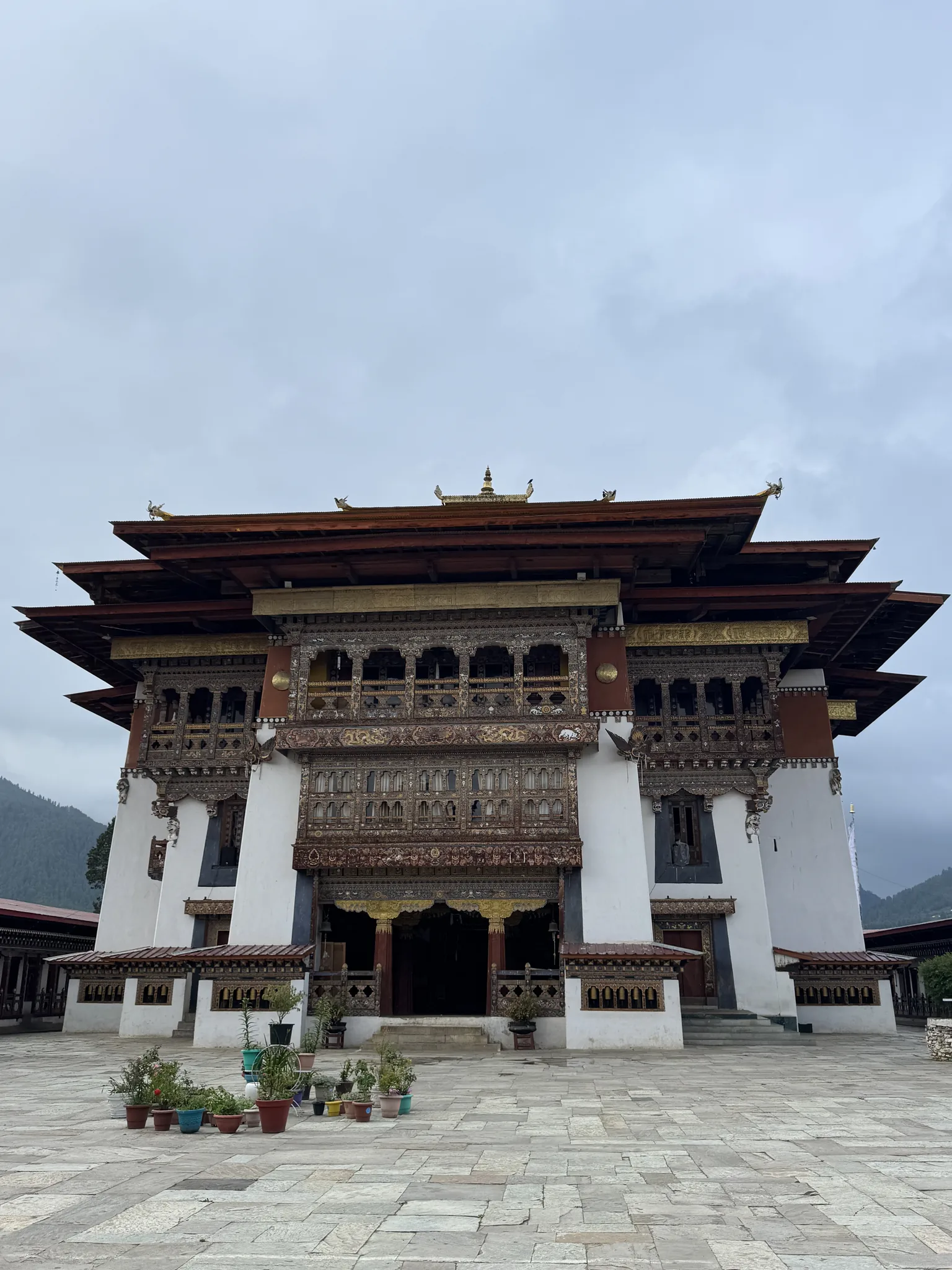
Gangtey Goenpa, whose courtyard holds the festival.
The Gangteng-Phobji valley is the largest winter home of black-necked cranes in Bhutan, with about 300 birds each year, according to the Royal Society for Protection of Nature (RSPN). The day includes folk songs, songs about the environment and mask dances by local people, schoolchildren and monks. The highlight is the crane dance, performed by schoolchildren.
RSPN started the festival in November 1998. It is organised by the Gangteng-Phobji Environment Management Committee and has been held at Gangtey Goenpa since 2005. In central Bhutan, the Jakar Tshechu in Bumthang is expected from 6 to 9 November 2027, the same week.
What Happens at a Tshechu
A tshechu is a religious festival held in a dzong or temple courtyard to honour Guru Rinpoche, who brought Buddhism to Bhutan in the 8th century. The word means "tenth day": these festivals fall on the tenth day of a month in the Bhutanese lunar calendar, the day associated with Guru Rinpoche.
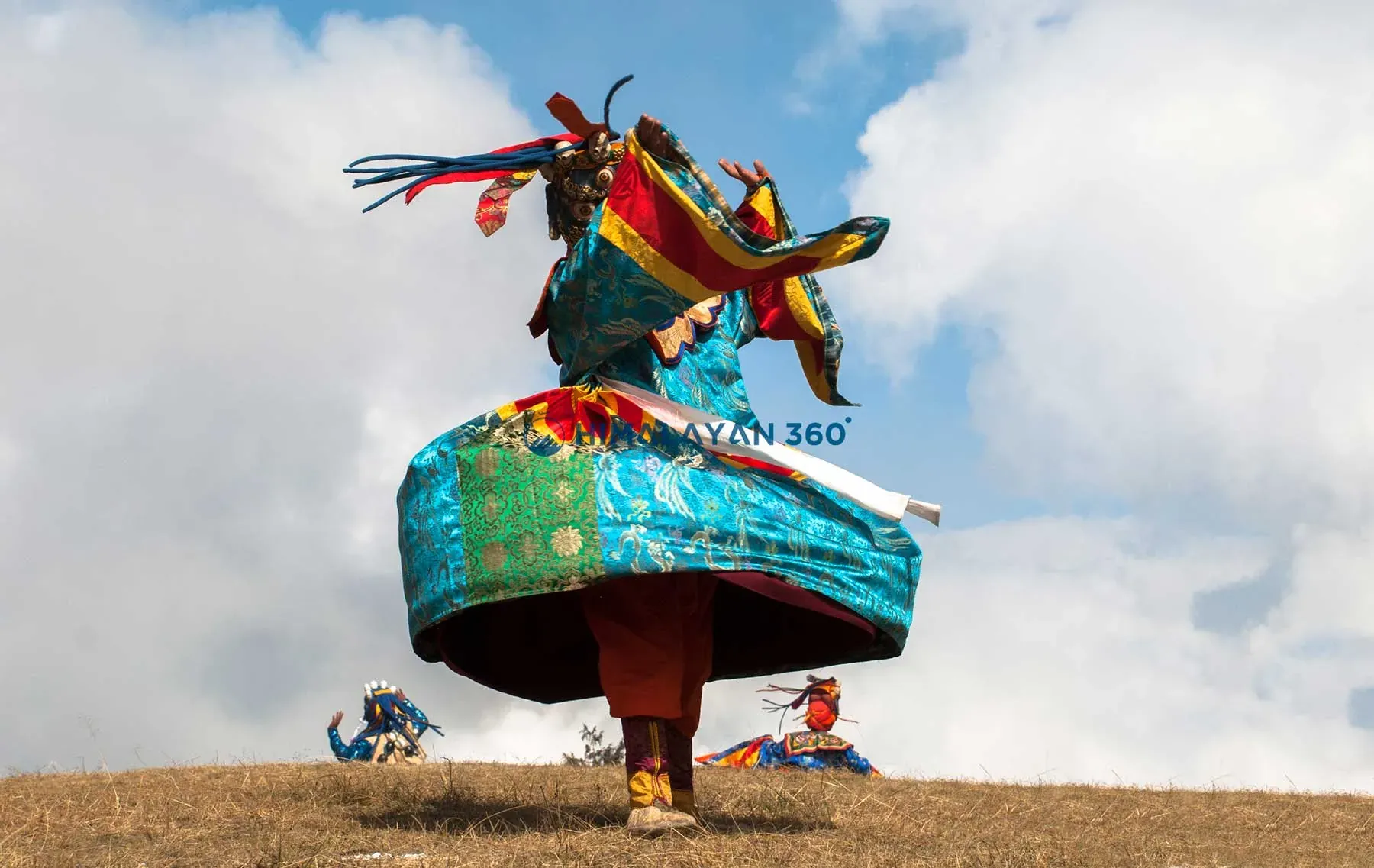
A cham dancer in a silk costume.
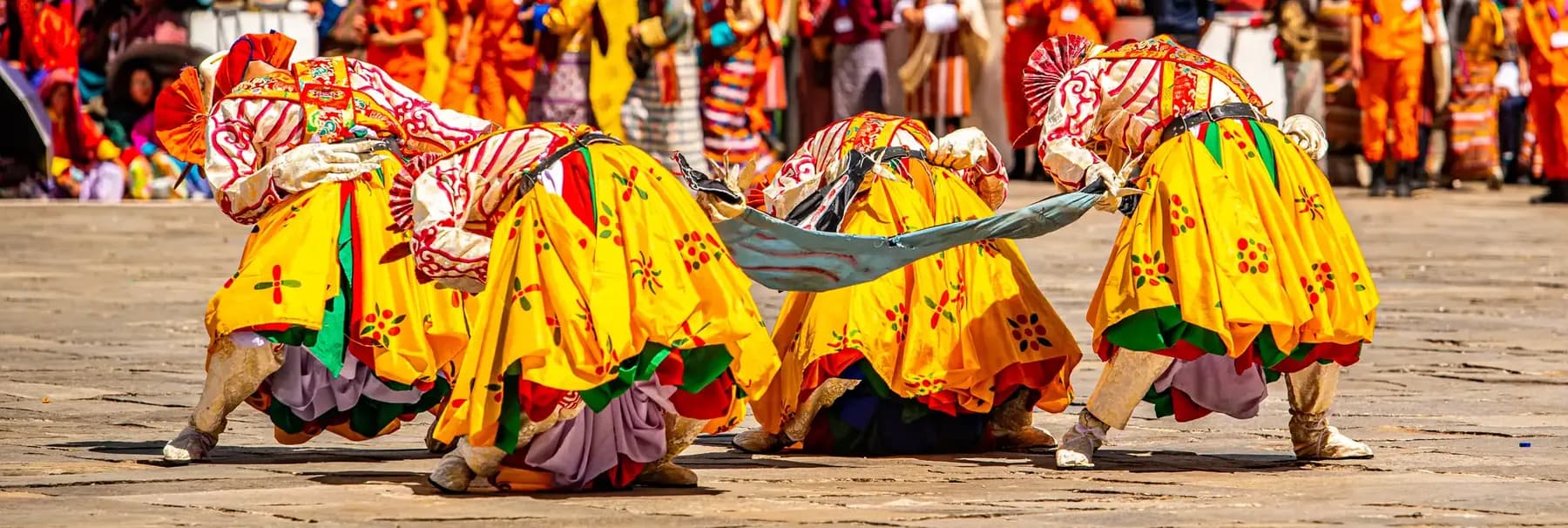
- Cham: monks and laymen in carved masks and brocade robes perform the sacred dances, which act out Buddhist stories. Each dance is believed to carry a blessing for everyone who watches.
- Atsara: masked clowns move through the crowd between the sacred dances, teasing children and visitors.
- The crowd: families come in their finest gho and kira, with picnics, and stalls sell food, textiles and prayer flags.
- Thongdrel: at the major tshechus, a giant embroidered scroll is unveiled at dawn on the last day. The name means roughly "liberation on sight".
- Length: a tshechu runs three to five days, and one full day is enough to see several dances.
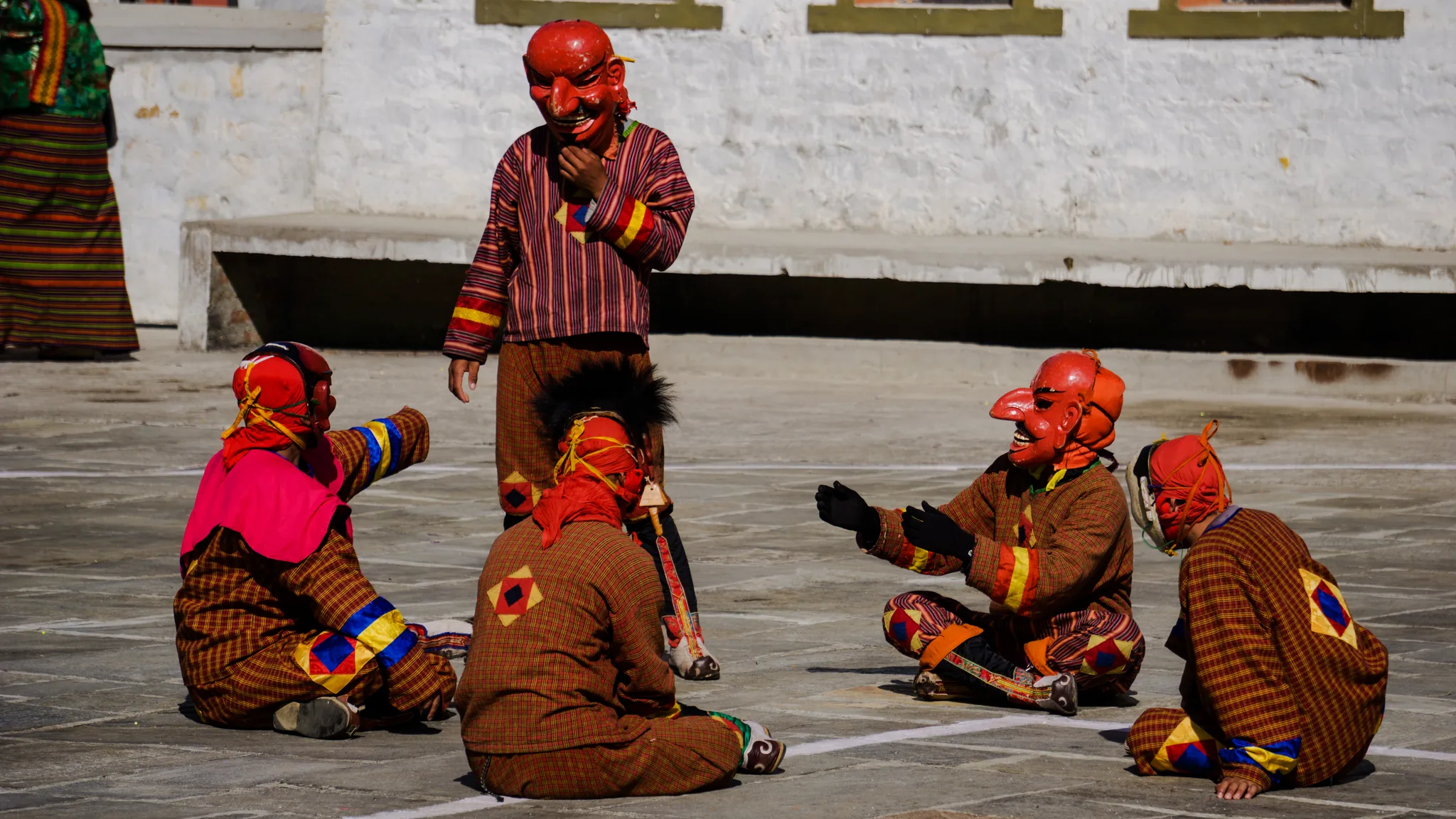
Performers in red masks on the festival ground.
Every international visitor in Bhutan travels with a licensed Bhutanese guide. Cover your shoulders and knees, and take hats off inside the dzong walls. Photos of the dances and the courtyard are allowed, but not inside the shrines. Few stalls take cards, so carry small notes in ngultrum.
Festival Tour Packages
Our Paro Tshechu Festival Tour is 8 days, built around the Paro Tshechu on 18 to 22 March 2027. After the festival it goes on to Thimphu, Punakha, the Phobjikha valley and the hike to Tiger's Nest. It is from USD 1,850 per person on a group basis, with the Sustainable Development Fee and the visa included.
For the Thimphu Tshechu in October, our 4 to 7 day Bhutan tours all visit Tashichho Dzong, where it is held:
All of them, with itineraries and what is included, are on Bhutan Tour Packages. Weather and festivals month by month are on Best Time to Visit Bhutan.
 Trek
 By air
 Pilgrimage
 Festivals
 Wildlife
 Luxury
 Yoga
 Food
 Heritage
